
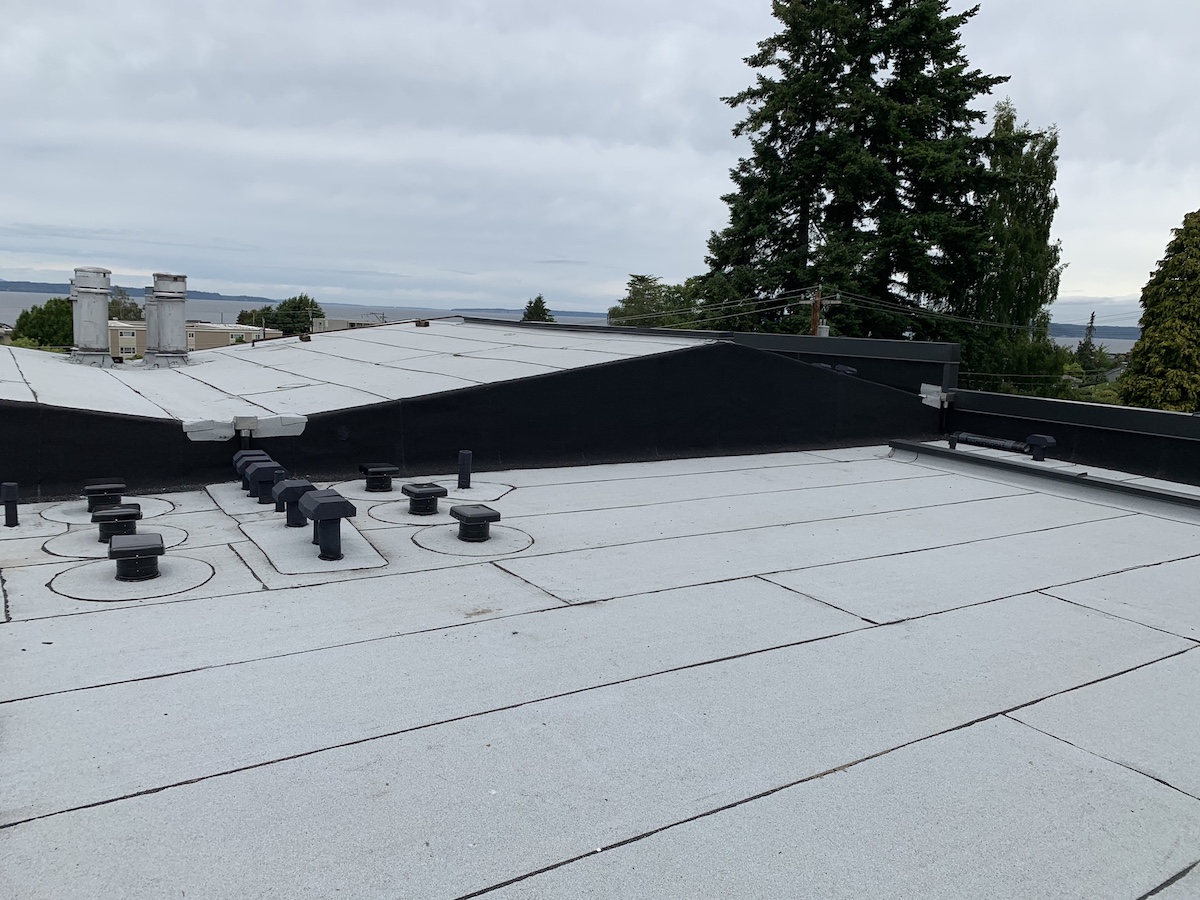
Modified Bitumen SBS and APP Roofing for commercial buildings across Dayton, Montgomery County, Kettering, Beavercreek, Fairborn, Huber Heights, Vandalia, Miamisburg, Centerville, Springboro, Troy, Xenia, and the Miami Valley.
Modified bitumen roofing — whether SBS (styrene-butadiene-styrene) or APP (atactic polypropylene) modified — occupies a strong position in Dayton's commercial roofing market because it solves the two-ply redundancy problem that single-ply systems can't address. A properly specified two-ply modified bitumen system provides two independent waterproofing layers over the insulation assembly, which matters on buildings where the consequences of a single-layer failure are significant: medical campus facilities, occupied office buildings, or the mixed-use historic properties in the Oregon District where water intrusion damages both building fabric and tenant operations simultaneously.
SBS-modified bitumen performs better than APP in Dayton's cold-weather conditions and is generally the preferred specification for two-ply systems in the Miami Valley climate. The styrene-butadiene-styrene polymer modification makes the bitumen matrix remain flexible at temperatures well below freezing — relevant in a climate where January roof surface temperatures regularly reach -10°F during cold snaps. APP-modified bitumen, which uses polypropylene polymer modification, provides better high-temperature performance but is less flexible in cold conditions. For Dayton applications where the roof surface will experience the full range from -10°F winters to 140°F summer surface temperatures, SBS-modified base sheets and SBS or hybrid cap sheets are the baseline specification.
Torch application is the traditional installation method for APP-modified bitumen and is used for SBS cap sheet application as well. Torch work on occupied buildings in Dayton — and particularly in the Oregon District and Webster Station neighborhoods where buildings share walls and the surrounding environment includes active pedestrian activity, parked vehicles, and adjacent tenants — requires strict fire safety protocols. Hot-torch application near combustible materials, HVAC air intakes, or occupied spaces below the roof deck creates fire risk and smoke infiltration risk that must be managed through pre-work safety planning, fire watch protocols, and staged application methods. Experienced contractors working in Dayton's historic commercial districts understand that torch work scheduling, monitoring, and fire safety coordination are non-negotiable project requirements.
Cold-adhesive application of modified bitumen eliminates the torch risk entirely by substituting solvent-based or cold-applied adhesive for the torch heat source. This method is particularly well-suited to Dayton building types where torch work is impractical: occupied buildings with air intake concerns, buildings with combustible substrate materials, and historic structures where open flame application near timber elements or historic fabric represents an unacceptable risk. Cold-adhesive application produces strong bond strength when applied according to manufacturer requirements — temperature above 50°F, proper adhesive spread rate, appropriate open time before membrane application — but the weather constraint is more significant than torch application, limiting the practical window to late spring through early fall in Dayton conditions.
Campus buildings at the University of Dayton and on the Kettering Health network represent a significant portion of Dayton's two-ply modified bitumen market. These institutional clients maintain rolling roof replacement programs that work through their building inventory on 15- to 25-year replacement cycles, and modified bitumen is frequently the specification of choice for buildings where two-ply performance, compatibility with existing BUR base layers, and long manufacturer warranty coverage are the selection criteria. Institutional clients in this market also tend to require specific documentation standards: project logs, inspection reports at each application phase, and warranty registration that meets the institution's asset management requirements.
The granule-surfaced SBS cap sheet is the standard finish layer on Dayton commercial modified bitumen applications. Ceramic-coated mineral granules in the cap sheet serve multiple functions: UV protection for the underlying bitumen matrix, fire resistance contribution, and walkway friction for maintenance personnel. Granule color selection affects thermal performance — darker granules absorb more solar heat and run hotter in Dayton's summer months, while lighter granules or reflective white granule cap sheets provide higher solar reflectance and lower surface temperatures. For Dayton buildings where energy code requires minimum solar reflectance values, reflective granule cap sheets or white-coated cap sheets are available and provide code compliance without converting to a different membrane chemistry.
Parapet wall and curb flashings on modified bitumen systems are typically executed in the same material — modified bitumen straps applied in multiple layers up the vertical face of parapet walls, equipment curbs, and penetrations. These vertical flashing applications are where application skill matters most: the modified bitumen must adhere to the vertical substrate without slumping during application, the laps between horizontal field membrane and vertical flashing must be correctly staged, and the termination height must be sufficient to provide water resistance against the standing water that develops at parapet walls during Dayton's peak storm events. Underpowered vertical flashings are the most common deficiency on modified bitumen roofs across the Dayton commercial market, found regularly during post-storm leak investigations.
Repair of modified bitumen roofs in Dayton uses the same modified bitumen material and heat-welding or cold-adhesive application method as the original installation. Small punctures and tears can be repaired with patch material bonded to the prepared existing surface. Larger damage areas require removing damaged material back to sound membrane and installing new material with proper overlap onto the existing system. Modified bitumen is one of the more forgiving membranes to repair in Dayton's climate — unlike single-ply TPO or EPDM that requires hot-air welding equipment or specific adhesive chemistry, SBS-modified bitumen patches can be executed with a propane torch in field conditions, making emergency repair on occupied Dayton buildings more accessible than comparable repairs on single-ply systems.
What to send before the roof walk
Send the roof address, leak photos, roof age if known, access instructions, tenant limits, prior reports, and the deadline driving the decision. That lets the first visit focus on the roof condition instead of chasing basic context.
Questions Owners Ask
What's the difference between SBS and APP modified bitumen?
SBS (styrene-butadiene-styrene) modification gives bitumen rubber-like elasticity, particularly at cold temperatures — the membrane stretches and returns to shape under Dayton's freeze-thaw cycling. APP (atactic polypropylene) modification produces a stiffer, more plastic membrane that performs better in high heat but is less flexible in cold. For Dayton applications, SBS is generally preferred for cold-weather performance. SBS cap sheets are installed by torching or cold adhesive; some SBS systems can also be self-adhered. APP is predominantly torch-applied. The two are not interchangeable in the same assembly without specific compatibility review.
Can modified bitumen be applied in Dayton's cold weather?
Cold-weather application of modified bitumen has genuine limitations in Dayton's climate. Torch application requires rooftop temperatures above freezing and no ice on the substrate for safe and effective bonding. Cold-adhesive SBS application requires ambient and substrate temperatures above 50°F for proper adhesive performance. Self-adhered SBS base sheets have the widest cold-temperature tolerance among application methods but still perform best above 40°F. Practically, modified bitumen application in Dayton is most reliable from April through October. November and March are marginal months that require careful weather monitoring. December through February is generally not a suitable application window without extraordinary measures.
How does a two-ply modified bitumen system compare to single-ply TPO?
The principal advantages of two-ply modified bitumen over single-ply TPO are redundancy and puncture resistance. If the cap sheet sustains a small breach, the base sheet provides a secondary barrier — a meaningful benefit on hospital campus and occupied institutional buildings in Dayton where the cost of water intrusion to operations is high. Two-ply modified bitumen also provides better puncture resistance for buildings with heavy rooftop traffic from maintenance personnel and trades. The advantages of TPO are faster installation, better solar reflectance, and typically lower installed cost. Both systems can achieve 20-year performance in Dayton's climate with proper installation and maintenance.
Is modified bitumen appropriate for the Oregon District historic buildings?
Modified bitumen is actually a good fit for many Oregon District and Webster Station buildings because it's compatible with the BUR systems that are likely already in place as a base layer. Cold-adhesive SBS application avoids the torch concerns on buildings with combustible historic fabric. The two-ply assembly provides redundancy appropriate for occupied commercial buildings where tenant disruption from a leak failure is costly. The main Oregon District complication isn't the material selection — it's staging and logistics in a constrained urban environment with pedestrian activity, shared walls, and limited crane or equipment access, all of which require experienced contractors familiar with the neighborhood.
What maintenance does a modified bitumen roof need in Dayton?
Annual inspection — spring and fall — is the baseline program. Spring inspection should assess granule condition on the cap sheet (looking for displacement or UV-degradation of the bitumen matrix beneath), flashing integrity at parapet walls and curbs, drain flow, and any visible surface cracking or blistering. Fall inspection should check that drains are clear before winter, assess flashing condition before freeze season, and identify any needed repairs that should be executed before sustained cold weather makes repair impractical. Prompt repair of identified seam or flashing conditions extends modified bitumen service life significantly — most premature failures are preventable with active maintenance programs.