
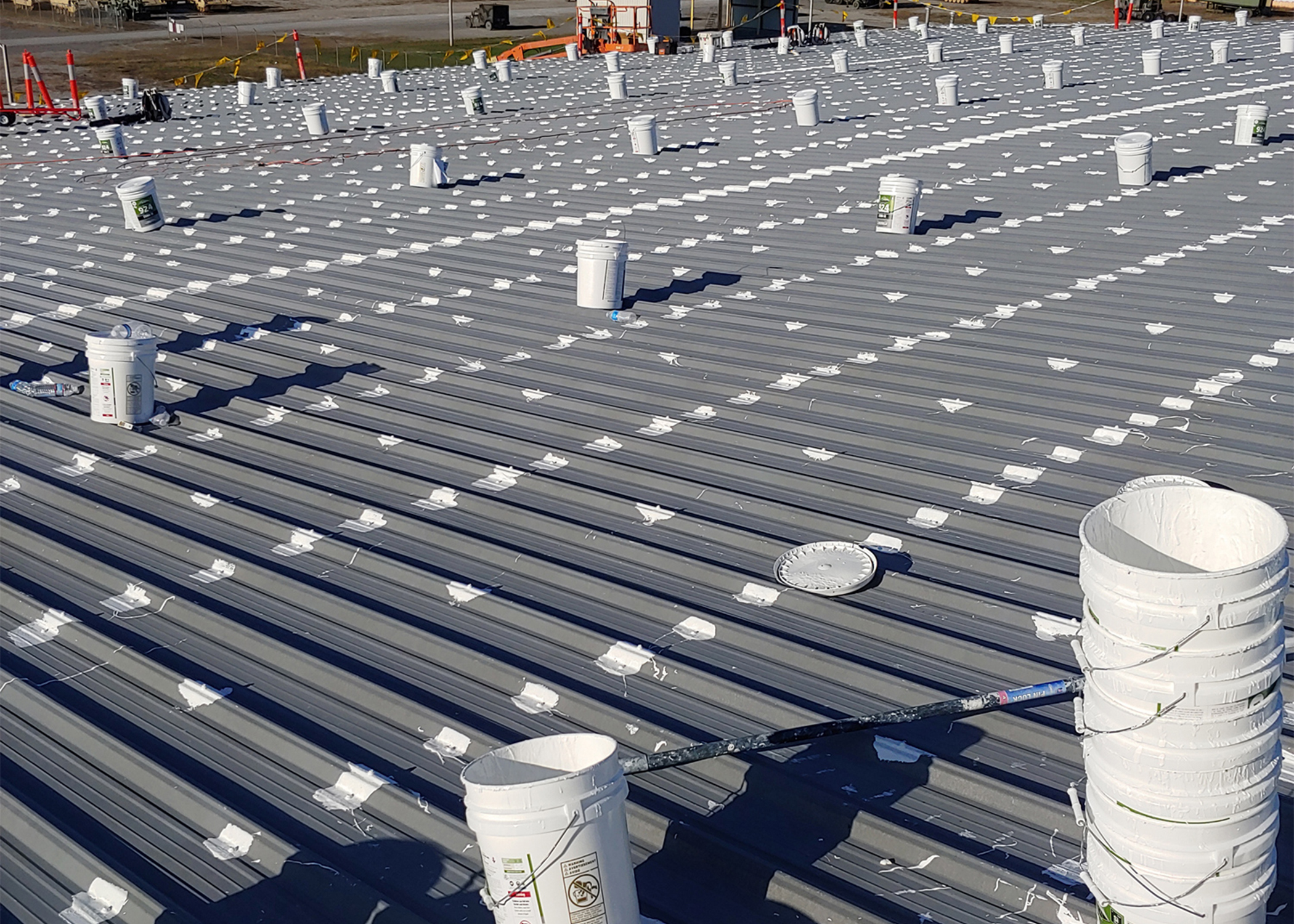
Acrylic and Silicone Roof Coatings for commercial buildings across Dayton, Montgomery County, Kettering, Beavercreek, Fairborn, Huber Heights, Vandalia, Miamisburg, Centerville, Springboro, Troy, Xenia, and the Miami Valley.
Dayton's climate doesn't make coating selection easy. You're working with freeze-thaw cycles that run from November through March, summer thunderstorm seasons that dump over four and a half inches of rain in May alone, and flat or near-flat commercial roofs across the Miami Valley that sit in ponded water after every significant event. Getting the chemistry right between acrylic and silicone coatings is the difference between a 10-year performance record and a failure at year three.
Silicone coatings are the dominant choice for ponding-water situations across Dayton's commercial building stock. The large flat roofs on Miami Valley Hospital's campus, the research pavilions at the UD Research Institute on Stewart Street, and the sprawling flex buildings along Needmore Road all share the same challenge: interior drain systems that can't evacuate standing water fast enough after a heavy July storm. Silicone maintains its elasticity and adhesion even when water sits on it for 48 hours or longer. Acrylic coatings, by contrast, soften and lose film integrity under sustained ponding — a problem that shows up fast in Dayton's storm pattern.
Where acrylic earns its place in the Miami Valley is on sloped surfaces: mansard sections, high-slope metal transitions, and the pitched portions of mixed-use buildings in the Oregon District and Webster Station. Acrylic's vapor permeability allows moisture to migrate out during warm-weather drying cycles — an advantage on substrates where some residual moisture is realistic after a Dayton winter. Silicone, being vapor-impermeable, locks in moisture if applied over a wet or marginally damp substrate, which is a serious installation risk from October through April.
Freeze-thaw cycling is the stress test that separates coating systems in this market. Dayton averages roughly 25 inches of annual snowfall, with the heaviest loading in January and February. A coating applied in October needs to survive repeated freeze-thaw expansion and contraction at seams, flashings, and field membrane transitions. Silicone remains flexible at temperatures well below freezing, making it the preferred chemistry for buildings with steel deck assemblies that move significantly with thermal swings — common in the Northwoods Industrial Park and Ascent Industrial Park building stock.
Substrate preparation is the step that determines whether any coating investment holds up. Core samples on older Dayton commercial buildings routinely reveal wet insulation layers from years of slow infiltration, particularly in buildings with gravel ballast or original coal-tar BUR. Applying either coating chemistry over wet insulation traps moisture, creates vapor pressure that delaminates the coating, and voids manufacturer warranties. Infrared scanning or nuclear gauge readings before coating work should be standard practice on any building that has been on the Montgomery County tax rolls for more than fifteen years.
UD Research Institute buildings present a coating consideration that most retail-focused contractors overlook: rooftop equipment density. Research facilities run HVAC equipment, exhaust systems, communication arrays, and specialty penetrations at far higher densities than a typical office building. Coating application around active equipment requires careful sequencing, and silicone's aggressive adhesion to HVAC curb flashings needs proper detailing to avoid restricting service access. Defense contractor buildings near WPAFB in Fairborn and Beavercreek face similar complexities with rooftop communication equipment.
Reflectivity claims for Dayton's climate need to be calibrated carefully. Marketing materials for both coating types advertise significant cooling-season energy savings, but Dayton averages only about 25 days above 90°F annually. The energy argument is real but modest compared to markets in the Deep South. The stronger case for white coatings in this market is thermal cycling reduction: high-reflectivity surfaces experience less daily temperature swing, which reduces expansion-contraction stress on membrane seams and flashings. That's a legitimate long-term benefit regardless of the cooling-load calculation.
Application window management matters in the Miami Valley. Silicone requires surface temperatures above 40°F and no rain forecast for a minimum cure window — conditions that are unreliable from November through March and variable in April. Most experienced Dayton commercial roofing contractors schedule coating projects between May and October, with close monitoring of the pop-up thunderstorm pattern that makes late-afternoon application risky in June and July. Acrylic coatings are even more temperature-sensitive and should not be applied when overnight temperatures will drop below 50°F within 24 hours of application.
Warranty structures for coating systems require attention to the re-coat interval. Most silicone manufacturers require an inspection and potential re-coat at year five or seven to maintain the full 10- or 15-year warranty. Building owners managing portfolios across the Dayton metro — particularly those with multiple buildings in Huber Heights, Vandalia, or the West Carrollton industrial corridor — should build re-coat inspections into their capital planning cycles rather than treating coating as a one-time expenditure.
What to send before the roof walk
Send the roof address, leak photos, roof age if known, access instructions, tenant limits, prior reports, and the deadline driving the decision. That lets the first visit focus on the roof condition instead of chasing basic context.
Questions Owners Ask
Can silicone be applied over an existing acrylic coating?
Generally no without significant surface preparation. Silicone does not bond reliably to acrylic surfaces in Dayton's temperature range. If you're converting from an existing acrylic system to silicone, the old coating typically must be removed or the surface profiled aggressively to give the silicone adequate adhesion. Get adhesion pull tests done before committing to an overlay approach.
How do I know if my roof has too much ponding water for acrylic?
A 48-hour observation after a significant rain event is the field test. If water remains on the field membrane more than 48 hours after the rain stops, it's classified as ponding and acrylic is not the right chemistry. Most of the flat roofing in Dayton's older commercial stock — particularly downtown and on hospital campuses — has some degree of ponding and should default to silicone.
What does substrate moisture testing involve before coating?
Infrared thermography is the standard non-invasive scan. It's typically performed in the evening or early morning when temperature differentials are greatest — wet insulation retains heat differently than dry insulation and shows up as warm spots. Nuclear gauge testing confirms moisture content at specific points. Core samples give you the most definitive answer but are destructive. Most Dayton coating projects of any scale should include IR scanning as a prerequisite.
Does Duke Energy Ohio offer any rebates for cool-roof coatings?
Duke Energy Ohio has offered commercial energy efficiency incentive programs, but roofing systems are generally not among the primary rebate categories — those tend to focus on HVAC, lighting, and building envelope insulation. Check the current Duke Energy Ohio Business Solutions program directly, as program offerings change. Some coating manufacturers have cooperated with utility programs in other markets, but Dayton building owners should verify current availability rather than assuming rebates exist.
How long does a silicone coating installation take on a 50,000 square foot roof?
On a clean, prepared substrate, a two-coat silicone application on a 50,000 square foot roof typically runs three to five days depending on crew size, equipment type (spray vs. roller), and weather windows. Substrate preparation — cleaning, priming, and detailing flashings — adds time and is the step most often rushed by lower-cost contractors. In Dayton's spring and fall seasons, weather delays should be budgeted into the project schedule.