
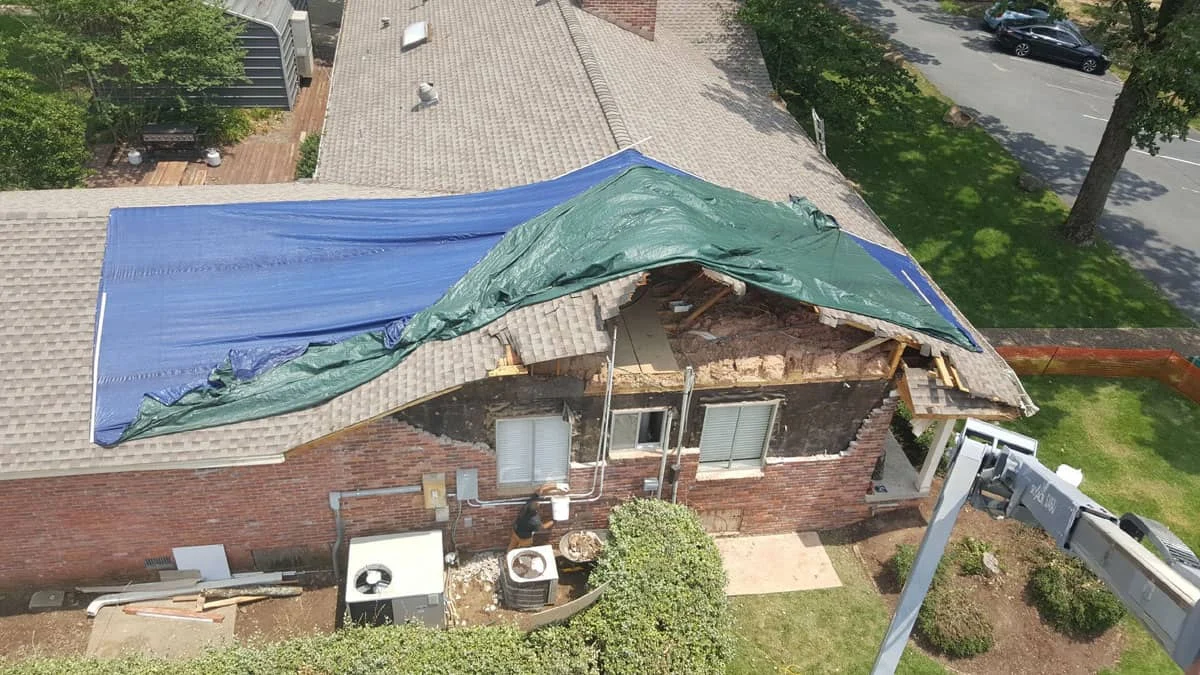
Storm Damage Roof Repair for commercial buildings across Dayton, Montgomery County, Kettering, Beavercreek, Fairborn, Huber Heights, Vandalia, Miamisburg, Centerville, Springboro, Troy, Xenia, and the Miami Valley.
Dayton's commercial corridors include the I-75 industrial strip, the Austin Landing and Miamisburg mixed-use zones, the Oregon District redevelopment area, and the defense-adjacent corridors near Wright-Patterson AFB. Storm damage documentation and insurance claim roofing in this market requires a contractor who can produce GPS-tagged hail impact maps, wind damage assessments, and supplemental claim documentation in the format that commercial property adjusters use — not just a repair estimate, but the evidence package that documents the claim at full scope.
The Miami Valley's severe storm season runs from April through October, with the peak danger window concentrated in May and June when Gulf moisture combines with jet stream dynamics to produce the convective storms that define this region's weather character. Dayton and Montgomery County sit in a zone where both tornado events and their more common cousin — severe straight-line wind events — are well-documented historical occurrences. The 2019 Memorial Day outbreak brought multiple EF2 and EF3 tornado touchdowns across the Dayton metro, demonstrating in a single night what the region's commercial building stock faces as a recurring risk. Commercial roofing systems that survive Dayton's storm season intact are systems that were properly designed, installed, and maintained — and the difference between those that do and those that don't becomes visible the morning after every major weather event.
Straight-line wind damage is the most common storm damage type across Dayton's commercial roofing inventory — significantly more common than direct tornado damage but capable of producing severe damage across broad areas. Straight-line winds from severe thunderstorms in the Miami Valley have been measured exceeding 70 mph in documented events, and wind at those speeds exerts uplift pressures on flat commercial roofing that test the design limits of mechanically fastened membrane systems. The weakest points in the system under uplift load are: membrane perimeter zones where wind uplift is highest (ASCE 7 design zone 3), flashing conditions where the membrane transitions to vertical surfaces, and seam conditions in mechanically fastened systems where the membrane is anchored at discrete fastener-and-plate locations rather than continuously. Post-storm assessment should systematically evaluate all three of these vulnerability zones rather than only inspecting visible damage.
WPAFB contractor buildings in Fairborn and Beavercreek face a post-storm repair coordination challenge that general commercial properties don't encounter: repair scheduling must work around operational requirements that are often not flexible. A defense contractor building where aircraft maintenance or precision component manufacturing continues through the repair period requires roof access coordination, debris management planning that prevents contamination of work areas below, and contractor security clearance arrangements that may take days to process even for emergency repair situations. Building owners managing these facilities who have pre-established relationships with security-cleared roofing contractors — contractors whose employees are already in the facility access system — save critical days in the post-storm response window compared to starting the contractor qualification process after damage has already occurred.
Hail damage documentation requires systematic coverage of the full roof surface rather than inspection of only the visibly damaged areas. A hail event typically affects a roof surface in a relatively uniform pattern — stones fall from a specific storm quadrant and impact the membrane at consistent angles and spacing. A thorough post-hail investigation documents the damage density (impacts per unit area) across the roof surface, characterizes the maximum stone size from impact diameter measurements, correlates observed damage with documented weather event data, and provides a written scope report that an insurance adjuster can review and respond to. Documentation that only covers selected areas or that fails to correlate observed damage to a specific weather event is insufficient for a successful commercial hail claim in the Dayton market.
Tornado-adjacent damage — damage from storms that didn't produce a direct tornado touchdown on the property but were in the vicinity of tornado events — often presents more variability in damage pattern than either straight-line wind or direct hail events. The turbulent winds associated with tornado development and the erratic debris field that severe thunderstorms can generate create damage patterns that are less predictable than the relatively uniform patterns of straight-line wind or large-hail events. Buildings along SR-35 corridor, in the Yellow Springs area, and across Greene County experienced significant variability in damage severity during the 2019 event — some buildings adjacent to each other had very different damage outcomes. Post-event inspection after a tornado or near-tornado event in the Dayton metro should not assume uniform damage based on a building's distance from the documented tornado path.
Emergency response capacity in the Dayton commercial roofing market contracts rapidly after major storm events. The 2019 Memorial Day tornadoes and subsequent significant storm events in the Miami Valley have repeatedly demonstrated that post-major-event contractor capacity is overwhelmed within 24 to 48 hours — every capable commercial roofing contractor in the metro area has a full schedule of emergency response calls. Building owners who are secondary in the response queue may wait a week or more for initial assessment. The practical response to this market reality is pre-storm relationship establishment: building owners who have ongoing service relationships with commercial roofing contractors, who appear on those contractors' priority client lists, and who have provided property access information in advance receive faster post-event response than property owners calling cold into a contractor queue after a major weather event.
Temporary repair quality after storm damage determines whether the building survives the next storm in reasonable condition while permanent repairs are planned and scheduled. A poorly executed tarp installation that shifts under post-storm wind, or a temporary sealant repair that fails in the first rain event after installation, compounds the damage situation and potentially complicates the insurance claim. Temporary repairs should be executed by the same quality contractor who will perform the permanent work, should be documented photographically before and after installation, and should be designed to withstand the weather conditions typical of the season in which they're installed. A temporary repair installed in June needs to survive Dayton's July thunderstorm season — not just stop the rain from the original storm event.
Scope consolidation after storm damage is an opportunity that building owners sometimes miss. When a storm event produces damage that triggers a significant insurance claim, the repair scope can legitimately include associated conditions that the storm exposed or worsened but that may have had some pre-existing deterioration. Re-flashing all parapet penetrations while the crew is already mobilized for storm damage repair at the parapet is more cost-effective than two separate mobilizations. Upgrading insulation R-value while a partial tear-off is already happening to address wet insulation from storm infiltration is a logical scope expansion. Working with both the insurance adjuster and your contractor to identify consolidated scope opportunities can produce a building improvement that goes beyond simply restoring pre-storm condition to the minimum required by the claim.
What to send before the roof walk
Send the roof address, leak photos, roof age if known, access instructions, tenant limits, prior reports, and the deadline driving the decision. That lets the first visit focus on the roof condition instead of chasing basic context.
Questions Owners Ask
What should I do immediately after a major storm damages my commercial roof?
Document the damage with time-stamped photographs before anything is moved or repaired. Notify your insurance carrier and request a claim number — do not wait until you have a full damage assessment to initiate the claim. Contact your commercial roofing contractor to schedule emergency response and temporary protection as needed. Protect interior assets from ongoing water exposure by moving equipment, covering with tarps, and running dehumidification in affected areas. Do not attempt to access the roof surface yourself immediately after a storm — post-storm roof surfaces can be compromised, slippery, and hazardous. Keep records of all expenses related to emergency response and interior damage mitigation for your insurance claim submission.
How do I know if my roof has wind uplift damage that isn't visible from inside?
Wind uplift damage to single-ply membranes often doesn't produce immediate interior leakage. Partially detached membrane perimeters may be lifted and returned by wind without fully blowing off, leaving the membrane marginally attached. Post-storm inspection should physically probe perimeter membrane edges and flashing conditions — membrane sections that were stressed by wind uplift may have lost adhesion or fastener engagement that is invisible from below but will fail under the next significant wind event. On mechanically fastened systems, checking fastener pull-through at membrane edges and in the field of the roof near high-uplift zones (corners and perimeters) is part of a thorough post-wind-event assessment.
Does my commercial property insurance cover tornado damage?
Yes — tornado damage is a covered peril under standard commercial property insurance policies. The practical complexities in the Dayton market are: documenting that a specific tornado event caused the observed damage (as opposed to pre-existing deterioration), quantifying the damage scope accurately when tornado damage can be spatially variable and difficult to bound precisely, and managing the claim process when a large number of properties are affected simultaneously and insurer resources are concentrated on higher-value or more straightforward claims. Working with a contractor experienced in post-tornado documentation and, if necessary, a public adjuster who specializes in commercial storm claims, produces better outcomes than navigating a complex tornado claim alone.
My neighbor's building was damaged but mine looks fine — should I still get an inspection?
Yes. Storm damage is spatially variable — wind direction, storm track, building orientation, and building geometry all affect which buildings in a storm's path sustain damage and which don't. A building that escaped visible damage may still have sustained structural stress to membrane perimeter conditions, minor hail impacts that don't penetrate but damage cap sheet granules, or flashing disturbance that isn't producing active leakage yet but is now a developing vulnerability. The cost of a post-storm inspection is minimal compared to the value of knowing your building's condition after a significant event. Many Dayton commercial building owners who skip post-storm inspections discover the damage they didn't notice during the following storm season.
How long does storm damage roof repair typically take in Dayton?
Minor storm damage repairs — isolated membrane blow-offs, individual flashing failures, localized hail damage — can typically be completed within one to three days once a contractor mobilizes for the work. Significant storm damage affecting large areas of membrane or requiring structural repairs may take one to three weeks. After a major regional storm event like the 2019 Dayton tornadoes, contractor backlog can extend project start dates by several weeks even for clients with established contractor relationships. Temporary protection work happens quickly; permanent repair scheduling is the step that gets extended in a post-major-event environment. Having your temporary repairs documented and your permanent repair scope quoted early helps you get into the repair queue before it extends further.