
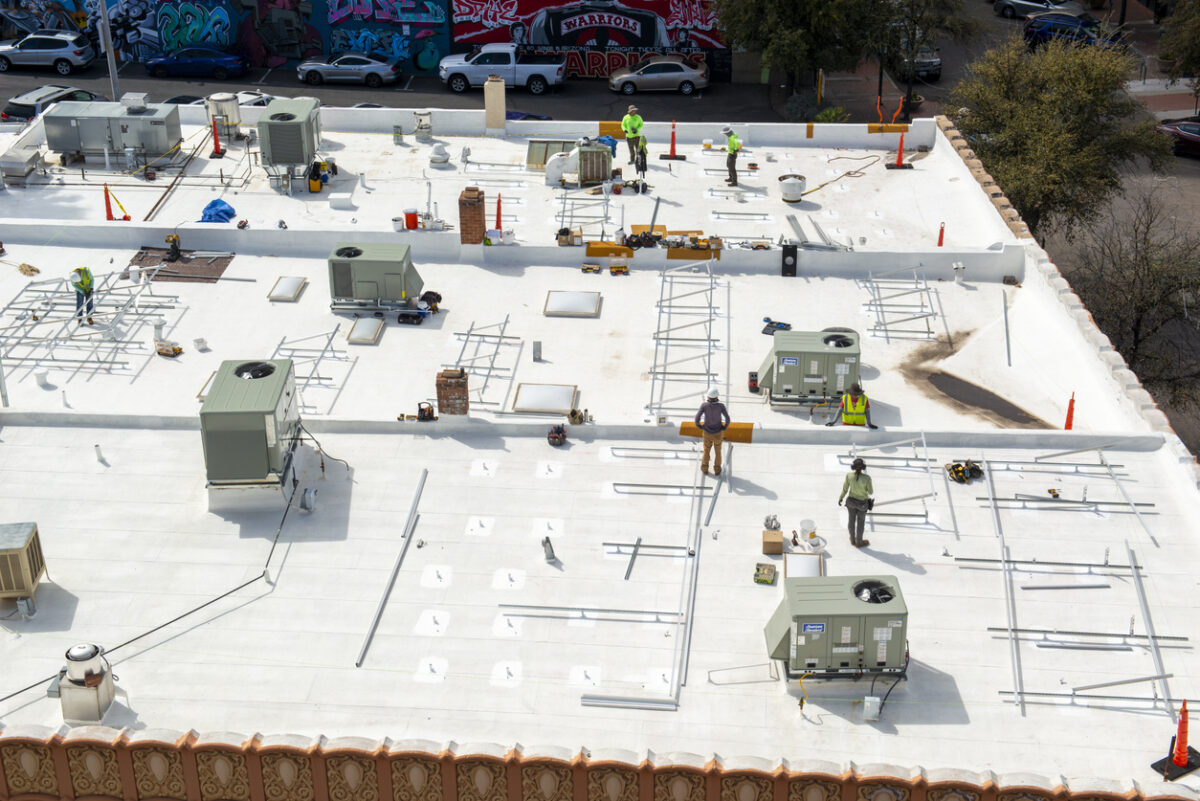
Commercial Roofing for commercial buildings across Dayton, Montgomery County, Kettering, Beavercreek, Fairborn, Huber Heights, Vandalia, Miamisburg, Centerville, Springboro, Troy, Xenia, and the Miami Valley.
Commercial roofing in the Dayton metro covers an unusually diverse range of building types concentrated in a relatively compact geography. Within thirty miles of downtown Dayton, you have active defense aerospace facilities at Wright-Patterson Air Force Base, Level I trauma centers and major medical campuses, a research university with hundreds of thousands of square feet of laboratory space, historic mixed-use commercial buildings from the early twentieth century, and an industrial corridor legacy from Dayton's manufacturing peak. Each of these building categories places distinct demands on roofing systems and the contractors who service them.
Wright-Patterson Air Force Base and the network of defense contractor facilities that cluster around it in Fairborn and Beavercreek represent the most demanding commercial roofing environment in the Miami Valley. WPAFB is one of the largest Air Force installations in the world, and the buildings on the base and in its surrounding business ecosystem span everything from precision manufacturing hangars to administrative office buildings to sensitive research facilities. Roofing work on WPAFB contractor buildings requires security clearance coordination, access control compliance, and in some cases documentation that meets DoD facility management standards. Contractors without experience in this market frequently underestimate the administrative and logistical requirements.
Medical campuses in Dayton present a different but equally demanding set of commercial roofing requirements. Miami Valley Hospital's main campus in downtown Dayton includes dozens of buildings of varying age and roof system types — some original construction, others from expansion programs spanning decades. Kettering Health Main Campus operates similarly. Roofing work on occupied hospital buildings must be phased to maintain patient care operations, must meet infection control construction standards when work is adjacent to occupied clinical areas, and must be coordinated with facilities management teams who maintain strict safety and operational protocols. These requirements are not negotiable and are not the same as working on a vacant industrial building.
The Oregon District and Webster Station neighborhoods represent Dayton's most visible historic commercial stock. These mixed-use buildings — many of them brick masonry construction from the early 1900s — typically have flat roofs with aging BUR or modified bitumen systems, parapet walls with deteriorating coping, and interior drain systems that were sized for a different building use pattern than they serve today. Roofing work in these neighborhoods is complicated by constrained staging areas, limited crane access, street-level pedestrian activity, and in some cases historic preservation review requirements. Experienced contractors understand that the logistics of a three-block radius in the Oregon District are completely different from a build in the Northwoods Industrial Park.
Industrial roofing along Dayton's major corridors — Northwoods Industrial Park, Ascent Industrial Park, Byers Road, and the Moraine industrial areas along I-75 — involves large, low-slope or near-flat roof areas, often with significant deferred maintenance histories. Many of these buildings have changed ownership multiple times as the auto supply chain industry contracted and diversified, and roof system documentation is frequently incomplete. Before any commercial roofing scope is defined on these buildings, moisture surveys and core sampling are essential to avoid specifying a recover when a tear-off is actually required due to wet insulation accumulation.
Dayton's weather profile defines the performance requirements for any commercial roof system specified in this market. The city receives 41 inches of annual precipitation, with peak monthly totals in May and June. Snowfall averages 25 inches per year, with the heaviest months being January at 8.3 inches and February at 6.6 inches. Freeze-thaw cycling — temperatures oscillating above and below 32°F — is the mechanical stress that drives flashing failures, membrane seam delamination, and coping failures across all building types. Any roofing system specified for a Dayton commercial building needs to be evaluated against this full range: summer thunderstorm peak loads, winter freeze-thaw stress, and the transition seasons where conditions are most unpredictable.
Roof system selection in the Dayton commercial market involves choices between single-ply membranes (TPO, EPDM, PVC, KEE), modified bitumen systems, traditional BUR, and specialty systems including spray polyurethane foam and standing seam metal. Each has appropriate applications depending on building type, occupancy, budget, and performance priorities. TPO dominates new commercial construction in the eastern suburbs — Beavercreek, Fairborn, Washington Township — where spec office and flex industrial buildings follow current energy code requirements. EPDM remains common in reroofing applications on older Dayton commercial and campus buildings where the existing substrate and drain system favor a recover approach. Modified bitumen is heavily used in downtown and medical campus applications where two-ply redundancy and compatibility with existing systems are priorities.
Capital planning for commercial roofing in Dayton should account for the full life-cycle cost of each system, not just installation cost. A TPO system installed on a Beavercreek corporate campus at $X per square foot has a different total cost picture than a modified bitumen system applied to an Oregon District building at a higher installation cost but with a documented 25-year service life in similar conditions. Duke Energy Ohio's commercial rate structures create some energy modeling incentive for high-reflectivity membrane selection, but the thermal cycling reduction argument is often more compelling than the cooling-load reduction argument for Dayton's climate zone. Building owners who plan capital expenditures on 10- and 20-year cycles get better value from roofing investments than those who respond reactively to visible failures.
The Miami Valley commercial roofing market supports contractors ranging from one-crew owner-operators to regional roofing companies with multiple Dayton-area crews. For building owners selecting a commercial roofing contractor for a significant project, the criteria that matter most in this market are: documented experience with your building type (defense contractor, medical, historic, industrial), manufacturer certification for the system being specified (which determines warranty availability), financial stability sufficient to complete a multi-week project without payment-driven interruptions, and verifiable references from comparable Dayton-area projects. The lowest bidder on a large commercial roofing project in Dayton frequently has the highest total cost when change orders, callbacks, and early system failures are factored in.
What to send before the roof walk
Send the roof address, leak photos, roof age if known, access instructions, tenant limits, prior reports, and the deadline driving the decision. That lets the first visit focus on the roof condition instead of chasing basic context.
Questions Owners Ask
What commercial roofing systems are most common in Dayton's climate?
TPO single-ply and EPDM single-ply dominate new construction and reroofing projects across the Dayton metro. Modified bitumen (SBS and APP) remains a strong choice for institutional buildings and older commercial stock. BUR is still actively maintained and occasionally specified new on buildings where multi-ply redundancy is a priority. Standing seam metal is the dominant choice for industrial and some corporate campus applications. PVC is used primarily in food-service and chemical-exposure environments along restaurant corridors and in defense contractor kitchen facilities.
How long does a commercial roof last in Dayton conditions?
A properly installed and maintained commercial roofing system in Dayton can be expected to achieve: 20-25 years for a quality TPO or EPDM single-ply system, 20-30 years for a modified bitumen two-ply system, 20-40 years for BUR depending on base construction, and 40+ years for standing seam metal. Dayton's freeze-thaw cycle stress and the severity of its thunderstorm season mean that maintenance — annual inspection, prompt repair of damage, drain cleaning — is the primary determinant of whether a system achieves the top or bottom of its expected service range.
What permits are required for commercial roofing work in Dayton?
Commercial roofing projects in Montgomery County and its municipalities require building permits for new roof systems and major reroofing projects. The City of Dayton Building Inspection department issues permits for work within city limits; Kettering, Beavercreek, Fairborn, and other suburbs have their own building departments. Permit requirements vary by project scope — a coating application typically requires a different permit category than a full tear-off and replacement. Experienced commercial roofing contractors handle permit applications as part of project setup and should be able to describe the specific requirements for your municipality.
Can I get financing for a commercial roofing project?
Several financing mechanisms are available for commercial roofing in Ohio. PACE (Property Assessed Clean Energy) financing is available for energy-efficiency improvements and can cover cool roofing and insulation upgrades. SBA loans can finance commercial property improvements including roofing. Some roofing manufacturers offer financing programs through their certified contractor networks. For building owners in Dayton's commercial districts, the City of Dayton's economic development programs have historically offered improvement loans for certain business districts. Consulting with your accountant about the tax treatment of roofing capital expenditures is also worthwhile — roof replacement may qualify for accelerated depreciation under current tax law.
What's the typical timeline for a commercial roofing project in Dayton?
Timeline depends heavily on roof size, system type, and weather. A single-story office building of 10,000 square feet with a straightforward TPO recovery can be completed in three to five days of actual work. A 100,000 square foot industrial tear-off and replacement may run three to five weeks with a full crew. Weather delays are a significant variable in Dayton — the spring and fall installation windows when conditions are ideal are also the windows most likely to see unpredictable weather. Most contractors build weather contingency into project schedules and have protocols for protecting open work areas during unexpected rain events.