
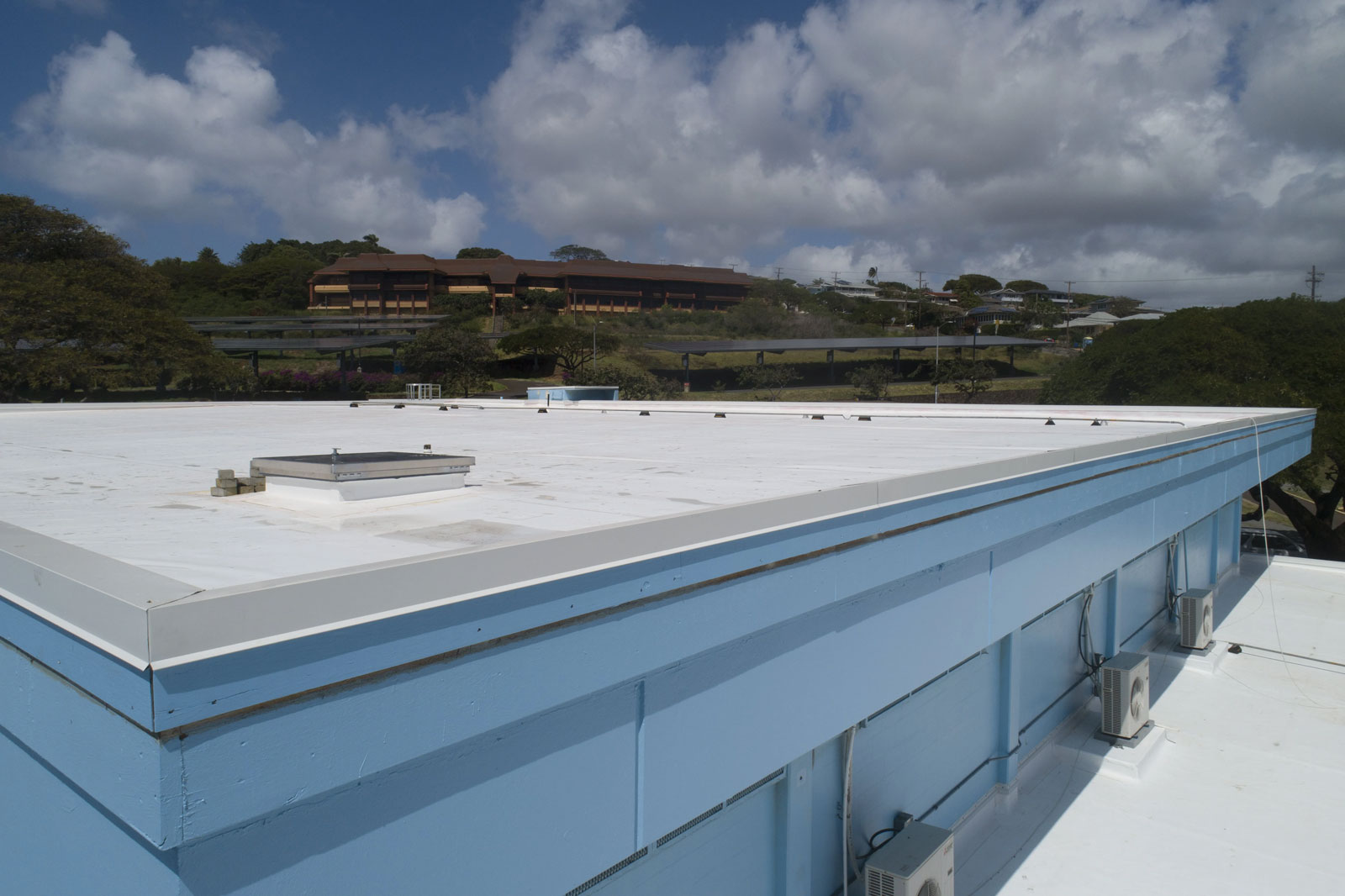
PVC Roofing for commercial buildings across Dayton, Montgomery County, Kettering, Beavercreek, Fairborn, Huber Heights, Vandalia, Miamisburg, Centerville, Springboro, Troy, Xenia, and the Miami Valley.
PVC roofing's defining commercial performance characteristic — resistance to grease, animal fats, and the chemical-laden exhausts from commercial kitchen ventilation systems — makes it the membrane of choice along Dayton's densest restaurant and food-service corridors. Wilmington Pike through Centerville and Washington Township is one of the most heavily developed restaurant corridors in the Dayton metro, with national chain restaurants, fast-casual operations, and anchor food tenants generating constant rooftop grease exhaust that would degrade TPO or EPDM membrane surfaces over time. Austin Landing's mixed-use development in Miamisburg includes multiple food-service concepts clustered in a pedestrian environment where roofing system performance directly affects tenant operations. PVC's documented resistance to the lipid and fatty acid compounds in kitchen exhaust is the reason it consistently appears in restaurant construction specifications.
Defense contractor buildings near WPAFB that include cafeteria or large-scale food service operations — and there are many, given the scale of the defense contractor workforce in Beavercreek and Fairborn — represent an institutional version of the same chemical exposure consideration. A defense contractor facility with a 500-person cafeteria and multiple commercial kitchen exhaust stacks on the roof is exposing its roofing membrane to the same chemical environment as a restaurant, but at a scale that may span a large percentage of a building's roof area. Facilities managers at these buildings who are evaluating reroofing options should assess the kitchen exhaust footprint on the existing membrane as part of their condition review — chemical degradation of the membrane around exhaust stacks is a leading edge case for specifying PVC rather than a standard TPO membrane.
Plasticizer migration is PVC roofing's primary long-term performance concern in Dayton's climate, and it's a concern that needs to be evaluated honestly before specifying PVC over any alternative. Traditional PVC membranes contain DOP (dioctyl phthalate) or similar plasticizers that make the membrane flexible at installation. Over time — particularly under UV exposure and the thermal cycling that Dayton's climate imposes — these plasticizers migrate out of the membrane. As plasticizer content decreases, the membrane becomes stiffer and increasingly brittle. In cold weather — Dayton's January conditions — a plasticizer-depleted PVC membrane can crack under the contraction stresses that are routine in this climate. Modern PVC formulations have improved plasticizer retention compared to 1980s and 1990s products, but the issue has not been entirely eliminated, and specifying PVC with documented plasticizer retention performance data is a more defensible approach than assuming all PVC membranes behave equivalently.
Centerville's commercial corridors along Wilmington Pike and Far Hills Avenue represent a mix of retail, restaurant, and medical office buildings that are common PVC roofing candidates. Many of these buildings were originally constructed in the 1980s through 2000s and are now entering their second or third roofing cycle. The concentrated restaurant density in these corridors means that even buildings whose primary use is not food service may have PVC installed as the standard specification for the whole retail center — either because there's a restaurant tenant in the building or because the property owner standardized on PVC for the portfolio. When these buildings are reroofed, evaluating whether the chemical resistance premium of PVC is warranted for the current tenant mix is a worthwhile exercise before automatically respecifying PVC simply because it was the previous system.
Heat-welded seam quality is the performance linchpin for PVC roofing in Dayton, just as it is for TPO and KEE. PVC seams are heat-air welded in the same general process as other thermoplastic membranes, but PVC welding parameters — temperature, speed, and pressure — differ from TPO. A welder who sets up their equipment for TPO and applies the same settings to PVC will produce inconsistent seam quality. The best commercial PVC installation in the Dayton market uses welding equipment with documented temperature calibration, operator training specifically on PVC welding parameters, and post-weld seam testing (probe testing and occasional destructive sample testing) to verify seam quality before the project is considered complete.
Drain connection detailing on PVC roofing systems deserves specific attention. PVC membrane is incompatible with certain drain body materials and adhesives — specifically, standard EPDM drain boots and some CPE-based drain accessories do not bond reliably to PVC membrane surfaces. PVC-specific drain collars and field-applied PVC pipe-boot flashings are the correct detailing for drain connections on PVC systems. On Dayton commercial buildings where an existing drain infrastructure is being retained during a reroofing project, verifying compatibility between the existing drain body materials and the new PVC membrane is part of the pre-specification due diligence that experienced contractors perform automatically and inexperienced contractors overlook.
White PVC membrane provides strong solar reflectance and meets Ohio's commercial energy code requirements for low-slope roofing. The same reflectivity characteristics that are marketed as a cooling-energy benefit also provide thermal cycling reduction — a more substantial performance benefit in Dayton's climate, as discussed in the energy code context. When PVC is specified for chemical resistance reasons, the energy code compliance benefit is essentially a free add-on for buildings where both considerations apply. Restaurant corridor buildings in Centerville or mixed-use developments at Austin Landing where PVC is driven by food-service chemical resistance needs also get the energy code compliance and thermal cycling reduction benefits without having to specify a different system for energy performance.
PVC recycling programs offered by some manufacturers address the end-of-life disposition of removed PVC membrane — a consideration that has become relevant to some Dayton institutional building owners and corporate campus facilities managers who have sustainability commitments or LEED certification goals. When a PVC roof reaches end of service life and is torn off during replacement, some manufacturer programs allow the old membrane to be returned for recycling rather than sent to landfill. For UD Research Institute buildings or Beavercreek corporate campuses where sustainability documentation is part of the facility's operating standards, asking about membrane recycling programs during contractor selection is a worthwhile conversation.
What to send before the roof walk
Send the roof address, leak photos, roof age if known, access instructions, tenant limits, prior reports, and the deadline driving the decision. That lets the first visit focus on the roof condition instead of chasing basic context.
Questions Owners Ask
Does PVC actually resist grease better than TPO or EPDM?
Yes — this is the most consistently documented performance differentiator for PVC in roofing applications. TPO membranes can be formulated with improved grease resistance, but base TPO is more susceptible to degradation from lipid and fatty acid compounds in kitchen exhaust than PVC. EPDM has relatively poor resistance to petroleum-based and organic chemical exposures. PVC's vinyl chloride polymer chemistry is inherently more resistant to the lipid compounds that dominate commercial kitchen exhaust. For buildings with significant food-service operations — restaurant chains along Wilmington Pike, institutional cafeterias, defense contractor dining facilities — PVC's chemical resistance is a legitimate and well-supported specification rationale.
How long does PVC roofing last in Dayton conditions?
Quality PVC roofing installed with proper seam welding and flashing details should achieve 15 to 20 years of service life in Dayton's climate with routine maintenance. The primary life-limiting factors are plasticizer migration (which drives brittleness and eventual cold-temperature cracking), seam delamination, and flashing failure at penetrations. Modern PVC formulations with improved plasticizer retention and heavier mil thicknesses (80-mil vs. 45-mil) are toward the upper end of this range. Buildings in the Oregon District or industrial areas where chemical exposure from adjacent buildings affects the rooftop environment should account for environmental factors that may accelerate deterioration beyond standard service life projections.
Can PVC be installed over an existing TPO roof?
Recovery of PVC over existing TPO is technically possible but requires specific compatibility review. PVC and TPO are not chemically compatible at the seam level — they cannot be heat-welded to each other. A PVC recover over existing TPO requires a complete recovery board layer between the systems so that new PVC seams weld to PVC field membrane without contact with the existing TPO below. The recovery board must also address any moisture content concerns in the existing assembly. Given the compatibility complications, full tear-off and replacement is often a simpler approach when switching from TPO to PVC at end of service life on a Dayton commercial building.
What causes PVC roofing to crack at seams in winter?
Winter seam cracking on PVC is the most visible manifestation of plasticizer migration. As plasticizer content decreases with age and UV exposure, the membrane loses flexibility and becomes unable to accommodate the thermal contraction stresses of Dayton's cold winter temperatures. Seams — which are the stiffest part of the assembly due to the heat-welded bond — are the most vulnerable points for cracking under contraction stress. Old PVC from the 1990s and early 2000s is particularly prone to cold-weather seam cracking. If you're seeing seam cracks appearing after cold spells on an aging PVC system, it's an indicator that the membrane has lost significant plasticizer content and is approaching end of service life.
Is PVC a good choice for non-restaurant commercial buildings in Dayton?
For buildings without food-service operations or other chemical exposure requirements, PVC is a viable but not typically optimized choice compared to white TPO. Standard white TPO provides similar energy code performance and comparable seam weld quality at lower material cost and without the plasticizer migration concerns. The cases where PVC makes sense for non-restaurant buildings are: buildings with access to specific manufacturer warranty programs that offer longer terms on PVC than TPO, buildings where a specific chemical exposure (non-food) drives the specification, or portfolio standardization situations where an owner manages a mix of restaurant and non-restaurant properties and prefers a single membrane specification across the portfolio.