
Insulation and Recovery Board for commercial buildings across Dayton, Montgomery County, Kettering, Beavercreek, Fairborn, Huber Heights, Vandalia, Miamisburg, Centerville, Springboro, Troy, Xenia, and the Miami Valley.
Insulation decisions in Dayton commercial reroofing are not just about R-value — they're about whether the substrate is dry enough to accept new roofing at all. The Miami Valley's freeze-thaw cycle is a reliable mechanism for driving moisture deep into roofing assemblies: water infiltrates through a failing membrane seam or flashing joint in October, freezes within the insulation in January, and the freeze-expansion process physically fractures foam insulation cells, accelerating moisture absorption in subsequent seasons. By the time a Dayton commercial building owner calls for a roofing assessment, the insulation beneath an aging membrane has often accumulated moisture loads that make a recover decision genuinely complex.
Recovery board — a thin, dimensionally stable insulation board product typically installed as the top layer of an existing assembly before a new membrane is applied — exists to solve a specific problem: providing a smooth, compatible substrate for the new membrane when the existing insulation surface is too irregular or incompatible for direct membrane adhesion. On Dayton industrial reroofing projects in Northwoods and Ascent Industrial Park, the existing polyisocyanurate insulation surface on aging mechanically fastened systems is often covered with residual adhesive, fastener plates, or surface irregularities that would telegraph through a new membrane without a recovery board layer. Recovery board creates a fresh, flat substrate for the new system.
The critical decision point before any recover project in Dayton is the moisture survey. Infrared thermographic scanning, nuclear gauge testing, and core sampling are the three tools used to assess existing insulation moisture content. IR scanning is the least invasive and most efficient for initial assessment — wet insulation retains heat differently than dry insulation and shows up as thermal anomalies when the roof surface is cooling after a warm day. Nuclear gauge testing measures moisture content at specific points without destroying the membrane. Core sampling removes a small plug of the assembly and allows direct visual inspection of moisture conditions layer by layer. For a Dayton industrial building with an aging membrane and no recent inspection history, a combination of IR scanning and core sampling at multiple points is the responsible pre-specification protocol.
Buildings on the University of Dayton campus and in the Kettering Health system present insulation assessment situations where the existing assembly is less predictable than it appears from the outside. Institutional buildings in Dayton have often been through multiple roofing cycles: an original 1970s BUR system, a 1990s recover with added insulation and new single-ply membrane, and perhaps minor repairs and maintenance since. The insulation layering in these assemblies can include incompatible materials — polyisocyanurate over fiberboard over original perlite insulation — that create thermal bridging and moisture storage characteristics very different from a modern assembly. Before specifying a second recover on an institutional building, the actual as-built assembly needs to be characterized from core samples rather than assumed from the roofing permit history.
Ohio's energy code requirements for reroofing insulation levels have evolved with each code edition adoption. The current Ohio Building Code requires minimum R-values for low-slope commercial reroofing that often require adding insulation above what was installed in the original or prior recover assembly. This energy code compliance requirement interacts with the IBC two-layer maximum: if a building is already at two layers and requires a tear-off, the tear-off is an opportunity to upgrade insulation to current standards before installing the new system. If a building is in its first reroofing cycle and can accommodate a recover, the recovery board layer can provide the opportunity to add insulation R-value to meet current code while also solving the substrate compatibility issue.
Polyisocyanurate (polyiso) is the dominant insulation board used in Dayton commercial roofing, both in new construction and in recovery assemblies. Its R-value per inch is superior to other foam board products, which matters when building height or parapet height constraints limit the total insulation thickness that can be added. However, polyiso has a cold-temperature performance characteristic that matters specifically in Dayton's climate: its effective R-value decreases at cold temperatures. A polyiso assembly that tests at R-25 under standard conditions performs at a lower effective R-value during Dayton's January cold spells. Specifying a tapered polyiso system with a cover board layer of high-density polyiso or mineral fiber board on the top surface is one approach used to manage both performance and code compliance in this climate zone.
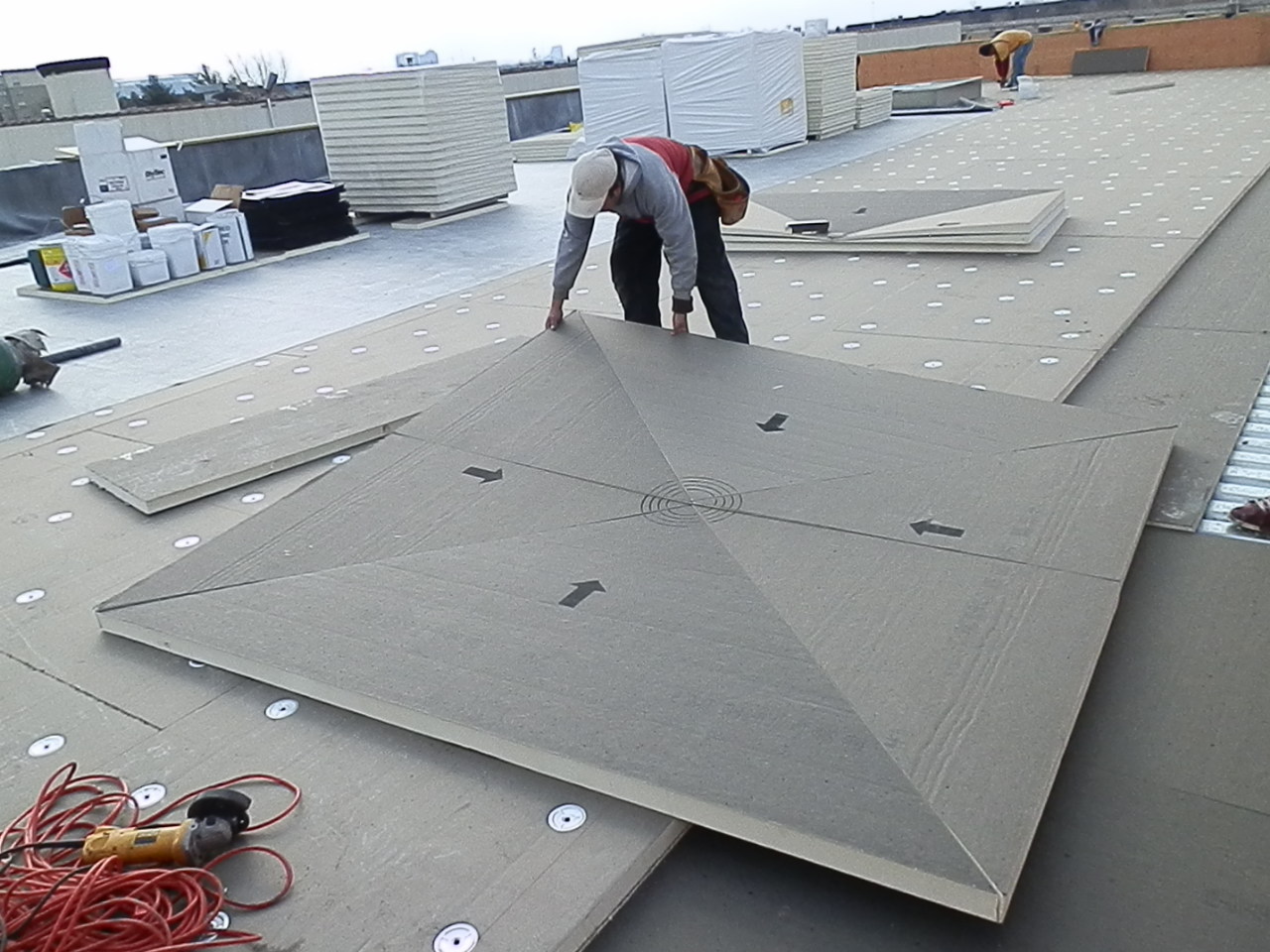
Tapered insulation systems address one of the most persistent problems in the Dayton commercial roofing stock: inadequate drainage slope on flat roofs. Many buildings in the Oregon District, along the industrial corridors, and on older institutional campuses were built with minimal or no positive drainage slope in the roof deck. The result is widespread ponding after rain events. Tapered insulation — designed using roofing crickets and tapered boards to create positive slope toward drains — can be installed as part of a recover or tear-off project to solve the drainage problem that has been driving premature membrane deterioration. The cost of a tapered system is higher than flat insulation, but the extended service life it provides by eliminating chronic ponding typically justifies the investment on Dayton commercial buildings with documented ponding problems.
WPAFB contractor buildings in Fairborn and Beavercreek often have specialized insulation requirements beyond standard energy code compliance. Defense and aerospace buildings may have thermal performance specifications tied to temperature-sensitive operations inside, or acoustic requirements for buildings near flight operations. Insulation specification for these facilities may need to be reviewed against tenant lease requirements or DoD facility standards rather than just Ohio Building Code minimums. Working with a contractor who understands how to document insulation system performance against multiple specification sets — not just the building permit code requirements — is important for maintaining lease compliance on WPAFB contractor campuses.
What to send before the roof walk
Send the roof address, leak photos, roof age if known, access instructions, tenant limits, prior reports, and the deadline driving the decision. That lets the first visit focus on the roof condition instead of chasing basic context.
Questions Owners Ask
How wet is too wet for a commercial insulation recover?
There's no universally agreed bright-line threshold, but most commercial roofing industry guidance and manufacturer installation requirements treat wet insulation areas as tear-off zones. If core samples show visible wet insulation — water dripping or dark saturation throughout the insulation thickness — that area must be torn off. If IR scanning shows isolated small wet spots comprising less than 25 percent of the total roof area, some approaches allow tear-off of those specific zones with recover over the remaining dry area. If moisture surveys reveal wet insulation in 25 percent or more of the roof area, the economics and performance arguments typically favor a full tear-off.
What's the difference between recovery board and standard insulation board?
Recovery board is specifically designed for use as the top layer in a recover assembly — it prioritizes dimensional stability, surface smoothness, and compatibility with membrane adhesives over maximum R-value per inch. Products like high-density polyiso cover board, mineral fiber board, and high-density fiberboard are common recovery board materials. Standard polyiso insulation board has higher R-value but a softer, less stable surface that can indent under foot traffic and membrane adhesive pressure. The best recovery assemblies in Dayton reroofing use a combination: standard polyiso for bulk R-value in the lower insulation layers, topped with a recovery board for substrate performance.
How much does adding insulation during a reroofing affect project cost?
Adding energy code-required insulation during a Dayton reroofing project typically adds $0.50 to $2.50 per square foot to the project cost depending on the thickness required, insulation product specified, and installation method. On a large industrial building of 100,000 square feet, that increment represents a meaningful capital cost but one that also locks in energy performance improvements and satisfies building code requirements that would otherwise need to be addressed separately. In most cases, the incremental cost of adding insulation during a planned reroofing project is substantially less than returning to add insulation as a standalone project later.
Does recovered insulation need to meet Ohio energy code even if I'm not doing a full replacement?
Ohio's energy code triggers for reroofing vary based on the extent of the project. Recovering an existing roof system — adding new membrane over existing layers — may trigger insulation upgrade requirements depending on the project scope and the specific code edition applicable to the jurisdiction. The requirement to bring insulation to current code standards when the existing insulation is being significantly altered or when the deck is exposed during tear-off is more clearly established. Consult with your contractor and the local building department for the specific requirements applicable to your project type in your municipality.
Can tapered insulation be added as part of a recover project?
Yes — tapered insulation is commonly installed as part of recover projects on Dayton commercial buildings with existing drainage problems. The new tapered insulation layer is installed over the existing flat insulation assembly (assuming moisture conditions permit) and creates the positive drainage slope toward existing drain locations. This approach is more cost-effective than adding tapered insulation at the deck level, which would require removing all existing roofing. The final assembly thickness is higher than the original, which may require parapet height adjustments and counterflashing raises in some cases — a detail that experienced contractors account for in the project scope.