
Acrylic and Silicone Roof Coatings for commercial buildings across Dayton, Montgomery County, Kettering, Beavercreek, Fairborn, Huber Heights, Vandalia, Miamisburg, Centerville, Springboro, Troy, Xenia, and the Miami Valley.
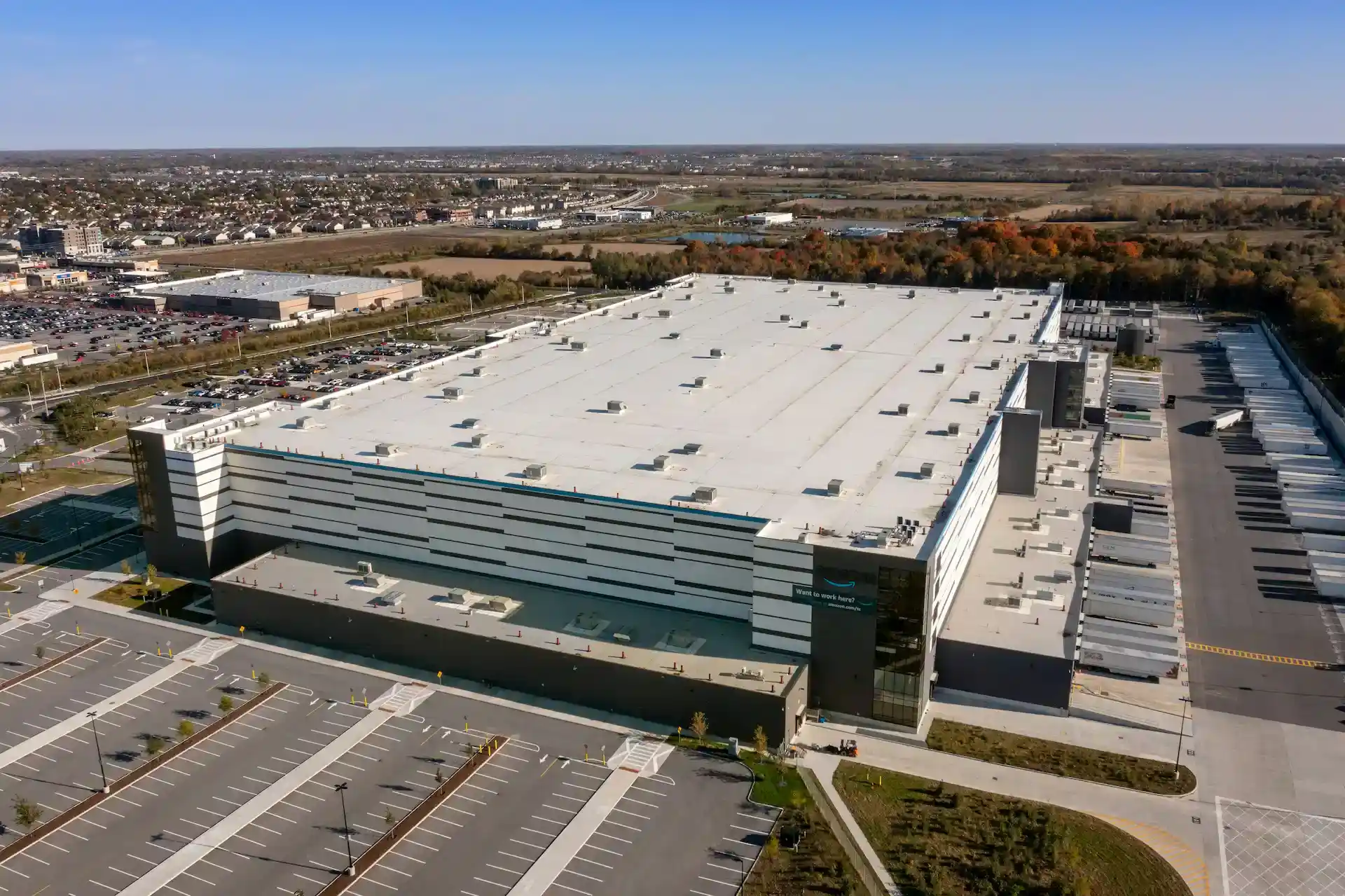
The Amazon Fulfillment Center in Tipp City, just north of Dayton, anchors a regional logistics network that depends on a roofing system capable of handling Ohio's complete four-season assault — heavy spring rains, intense summer heat spikes, and the lake-effect-influenced winters that regularly dump significant snow loads on Montgomery County's flat industrial rooftops. Dayton has developed into a major Midwest logistics hub partly because of its highway and rail infrastructure, and the warehouse and distribution buildings serving that hub face demanding roofing requirements that differ meaningfully from Sun Belt facilities.
Snow load engineering is the single most important structural consideration for Dayton warehouse roofing that has no equivalent in southern markets. Ohio's ground snow load values translate to roof design loads that, when combined with rain-on-snow events and drifting near parapet walls and rooftop equipment, can temporarily produce localized loads that exceed design limits on older structures. Drain design must account for ice formation over drain bowls and downspout freezing, which means heating cables at critical drainage points are a standard specification element rather than an optional upgrade. Any replacement project should include a drain freeze-protection assessment as part of the scope.
EPDM has historically dominated Dayton warehouse roofing because of its excellent low-temperature flexibility and long track record in the Ohio climate. Fully adhered and mechanically attached EPDM systems remain highly competitive for large footprints in the region, particularly on re-cover projects where the black surface actually provides a modest heating benefit during Dayton's six-month heating season. TPO in white has gained market share as energy codes have tightened and facility managers in air-conditioned warehouses have run the numbers on summer cooling cost reduction, but the reflectivity benefit must be weighed against Ohio's heating-season energy profile across the full calendar year.
Dock door penetration flashing on Dayton warehouses has a specific freeze-thaw challenge at wall transitions. The cycling of temperatures above and below freezing dozens of times per winter season works sealants and metal flashings at penetration points far harder than in warmer climates. Contractors working in the Dayton market should specify sealants rated for low-temperature application and flexibility, and the inspection cycle after each winter season should prioritize the perimeter flashing at dock walls where freeze-thaw cycling is most aggressive. Buildings with north-facing dock walls are particularly vulnerable because snow accumulation at the truck court holds against the flashing and melts slowly.
Rooftop forklift exhaust and ventilation equipment on Dayton distribution centers must be flashed with curb heights that account for the snow accumulation that develops around rooftop penetrations during winter storms. A curb that meets minimum code height in a Snow Belt market is not necessarily adequate when multi-day snowfall events pile up around HVAC curbs and create melt pathways toward the curb flashing. Eight-inch minimum curb heights are standard practice for Dayton warehouse projects, and snow guards around critical equipment curbs are worth the additional cost to prevent sliding snow from impacting flashing integrity.
The Dayton climate also demands attention to condensation control in warehouses that are heated during winter. Warm, moist interior air rising through the deck and into the roof insulation causes moisture accumulation that can deteriorate insulation R-values over time and eventually lead to membrane delamination. A vapor retarder specified correctly for the assembly's dew point position is essential on new insulation installations, and the re-cover vs. tear-off decision on existing Dayton warehouse roofs should always be preceded by a moisture scan to quantify how much wet insulation is already present in the system.
Energy efficiency calculations for Dayton warehouses must treat the heating and cooling seasons as roughly equal contributors, unlike Sun Belt facilities where cooling dominates. Polyisocyanurate insulation performs exceptionally well in heating-dominated climates at the nominal R-values published by manufacturers, though specifiers should note that PIR's effective R-value decreases slightly at very low temperatures. For large climate-controlled Dayton warehouses, the insulation specification should be reviewed by an energy consultant to optimize thickness for the specific heating and cooling loads of the building rather than defaulting to a one-size-fits-all specification.
Cost per square foot on Dayton warehouse roof replacements typically runs between $7 and $11 for a complete single-ply system with insulation, competitive with other Midwest markets of similar size. The Dayton market has several regional roofing contractors with strong large-building experience and manufacturer certifications, and the competitive bidding environment generally produces fair pricing on straightforward projects. Owners should budget an additional $0.50 to $1.50 per square foot for drain modifications and freeze protection upgrades on facilities that are being brought up to current Ohio standards.
Maintenance planning for Dayton warehouse roofs should include a specific post-winter inspection each spring to catch the freeze-thaw damage that accumulates over the heating season. Membrane seam separations at perimeters, cracked sealants at penetration flashings, and metal flashing separations at parapets are the most common findings in spring inspections on Dayton warehouse roofs that have been through a hard winter. Addressing these items in April or May, before spring rains begin, prevents the minor damage from becoming a major leak event that disrupts active distribution operations.
What to send before the roof walk
Send the roof address, leak photos, roof age if known, access instructions, tenant limits, prior reports, and the deadline driving the decision. That lets the first visit focus on the roof condition instead of chasing basic context.
Questions Owners Ask
Can this work happen while the building is occupied?
Often yes. The scope should cover access, safety, dry-in, staging, noise, interior protection, and the times when tenants or operations cannot be interrupted.
What changes the cost most?
Wet insulation, deck condition, edge metal, layer count, access, roof size, code triggers, weather timing, and the amount of repeated damage usually move the cost.
How is the condition documented?
The roof file should include photos, locations, material notes, observed defects, temporary repairs, remaining deficiencies, and recommended next steps.