
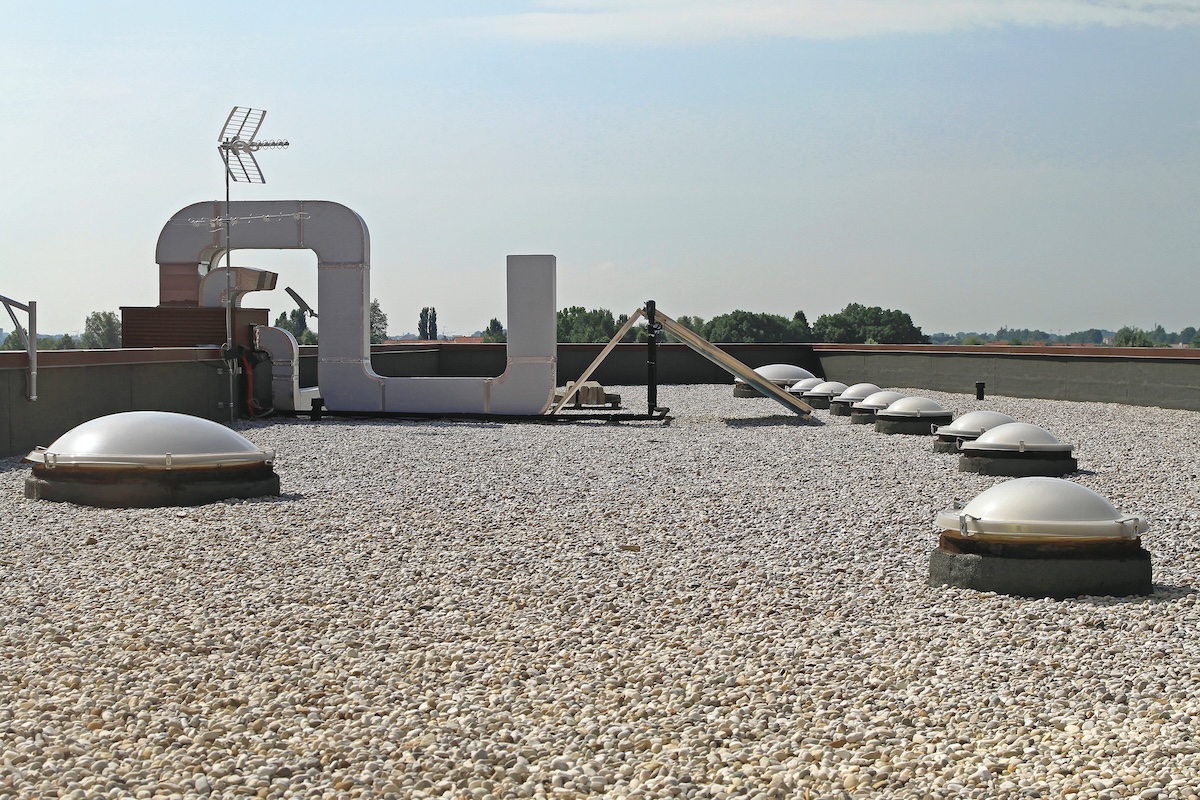
Built-Up Roofing for commercial buildings across Dayton, Montgomery County, Kettering, Beavercreek, Fairborn, Huber Heights, Vandalia, Miamisburg, Centerville, Springboro, Troy, Xenia, and the Miami Valley.
Built-up roofing is part of the structural DNA of Dayton's older commercial building stock. Walk through the Oregon District, Webster Station, or the warehouse conversions along East Third Street and you are almost certainly standing beneath a BUR assembly — multiple layers of bitumen-saturated felt alternated with hot-mopped asphalt or coal tar, finished with aggregate surfacing that has been on the roof for decades. These systems were installed when Dayton's manufacturing economy was at its peak, and they remain in service because, when they were built correctly, they are extraordinarily durable.
The aggregate-surfaced BUR that dominates Dayton's historic commercial inventory creates a specific maintenance challenge: gravel migration and drain blockage. Over time, foot traffic, thermal cycling, and wind scatter the aggregate cap layer toward roof perimeters and drains. Drains clogged with displaced gravel are among the most common causes of ponding-related membrane failure in the Oregon District and Webster Station building stock. Annual drain cleaning and aggregate redistribution are not optional maintenance items on these roofs — they are the difference between a functioning system and an accelerating failure.
Hospital campus buildings in Dayton carry a significant BUR legacy. Miami Valley Hospital's older structures and portions of Dayton Children's Hospital were built during the construction boom of the 1960s and 1970s, when BUR was the dominant flat-roofing specification for institutional buildings. Many of these assemblies have been patched, recoated, or recovered over the decades but still contain original felts and bitumen at their base layers. Core sampling before any major capital roofing decision on these buildings reveals whether the existing assembly can support another recover or whether a full tear-off is warranted.
Coal-tar BUR, which was common on Dayton commercial buildings through the 1970s, behaves differently from asphalt BUR and requires specific handling. Coal tar remains self-healing at temperatures reached on a dark Dayton roof in July — small punctures and minor membrane separations can re-fuse when the material reaches its softening point. This self-healing characteristic has kept many coal-tar roofs alive well beyond their design life. However, coal tar also presents regulatory considerations for debris disposal during tear-off: waste coal-tar materials are handled as a special waste category, and debris logistics on occupied sites like downtown Dayton medical facilities require advance coordination with disposal contractors.
Freeze-thaw performance is where BUR's multi-ply construction gives it a genuine advantage over single-ply membranes. Each layer of felt provides a redundant barrier, and the bitumen matrix remains stable through Dayton's January and February freeze cycles. The failure mode for aging BUR in this climate is not sudden catastrophic failure but gradual alligatoring — surface oxidation and cracking of the bitumen matrix that allows water infiltration to begin working its way through the felt layers. Catching alligatoring in the early stages through routine inspection allows for surface treatment rather than full replacement.
Historic preservation requirements add a layer of complexity to BUR work in the Oregon District and Webster Station. Some properties in these districts carry local landmark designation or are contributing structures within historic overlay zones. Roofing system changes that affect the character-defining features of these buildings — parapet heights, cornice lines, rooftop visibility from adjacent properties — may require approval from the City of Dayton's historic preservation program. Experienced commercial roofing contractors working in these neighborhoods understand the approval process and can coordinate documentation to support permit applications.
Industrial buildings in Moraine and the West Carrollton corridor represent a different BUR context. These structures — many of them former auto-supply chain facilities — tend to have large, low-slope roof areas with aged BUR assemblies that have been in service through decades of industrial operation. Chemical exposure from manufacturing processes, foot traffic from rooftop mechanical maintenance, and years of deferred capital investment make condition assessment on these buildings essential before any scope-of-work determination. A building that looks like a recover candidate from the outside may have wet insulation through 40 percent of its area once core samples are taken.
New BUR installation remains viable in Dayton's commercial market for owners who prioritize longevity and redundancy over cost-per-square-foot. Modified BUR systems using fiberglass reinforced felts and polymer-modified bitumen cap sheets deliver improved cold-weather flexibility compared to the original organic felt systems and are compatible with the coal-tar or asphalt base layers common in recovery assemblies. Specifying the right base sheet, interply felts, and cap sheet chemistry for a Dayton climate — where the system will face temperatures from -10°F to 95°F within a single year — requires a contractor who understands the difference between a spec that works in Atlanta and one that holds up in the Miami Valley.
What to send before the roof walk
Send the roof address, leak photos, roof age if known, access instructions, tenant limits, prior reports, and the deadline driving the decision. That lets the first visit focus on the roof condition instead of chasing basic context.
Questions Owners Ask
How do I know if my BUR has coal tar versus asphalt?
The smell is the most immediate indicator — coal tar has a distinctive petroleum odor that is stronger and more persistent than asphalt. Visual inspection shows coal tar as a darker, more uniform black surface with a slightly different texture than asphalt BUR. Core sampling and lab testing will give you a definitive answer. This matters for repair material compatibility: coal tar and asphalt are not compatible and cannot be mixed in repair applications.
Can I recover over an existing BUR without a full tear-off?
Recovery is possible if moisture readings and core samples show the existing insulation is dry and the membrane is structurally sound. Most Dayton BUR assemblies from the 1970s and 1980s that have not had documented maintenance programs will show some wet insulation areas. IBC allows a maximum of two roofing layers, so if your building already has a previous recover layer installed, a full tear-off is required regardless of moisture content.
What are the staging constraints for BUR work on an occupied Oregon District building?
Hot-mop BUR work in a dense urban commercial environment requires odor management, hot bitumen kettle placement that complies with fire codes and doesn't block pedestrian access, and debris containment that protects adjacent businesses and parked cars. Modified bitumen torch-down alternatives reduce some of the odor and logistics challenges. Scheduling work in early morning hours before business traffic increases also helps manage neighbor relations in tight historic district environments.
How long does a BUR system last in the Dayton climate?
A properly installed aggregate-surfaced BUR system in Dayton should achieve 20 to 30 years of service life with routine maintenance. Systems from the 1960s and 1970s that are still in service demonstrate that 40-plus years is achievable under favorable conditions. The most significant life-shortening factors in the Miami Valley climate are neglected drain maintenance leading to chronic ponding, deferred repair of alligatoring surfaces that allow water infiltration, and physical damage from heavy HVAC equipment installation or replacement.
Is hot-mopped BUR still available or are contractors moving away from it?
Hot-mopped BUR is still available and still specified in Dayton's commercial market, though the number of crews experienced with hot-mop application has declined compared to 20 years ago. Many contractors have shifted toward modified bitumen systems that use torch-application or cold-adhesive application as alternatives. For historic buildings where an in-kind BUR match is specified, or for institutional owners who prefer the multi-ply redundancy of traditional BUR, qualified hot-mop crews can be sourced in the Miami Valley market.