
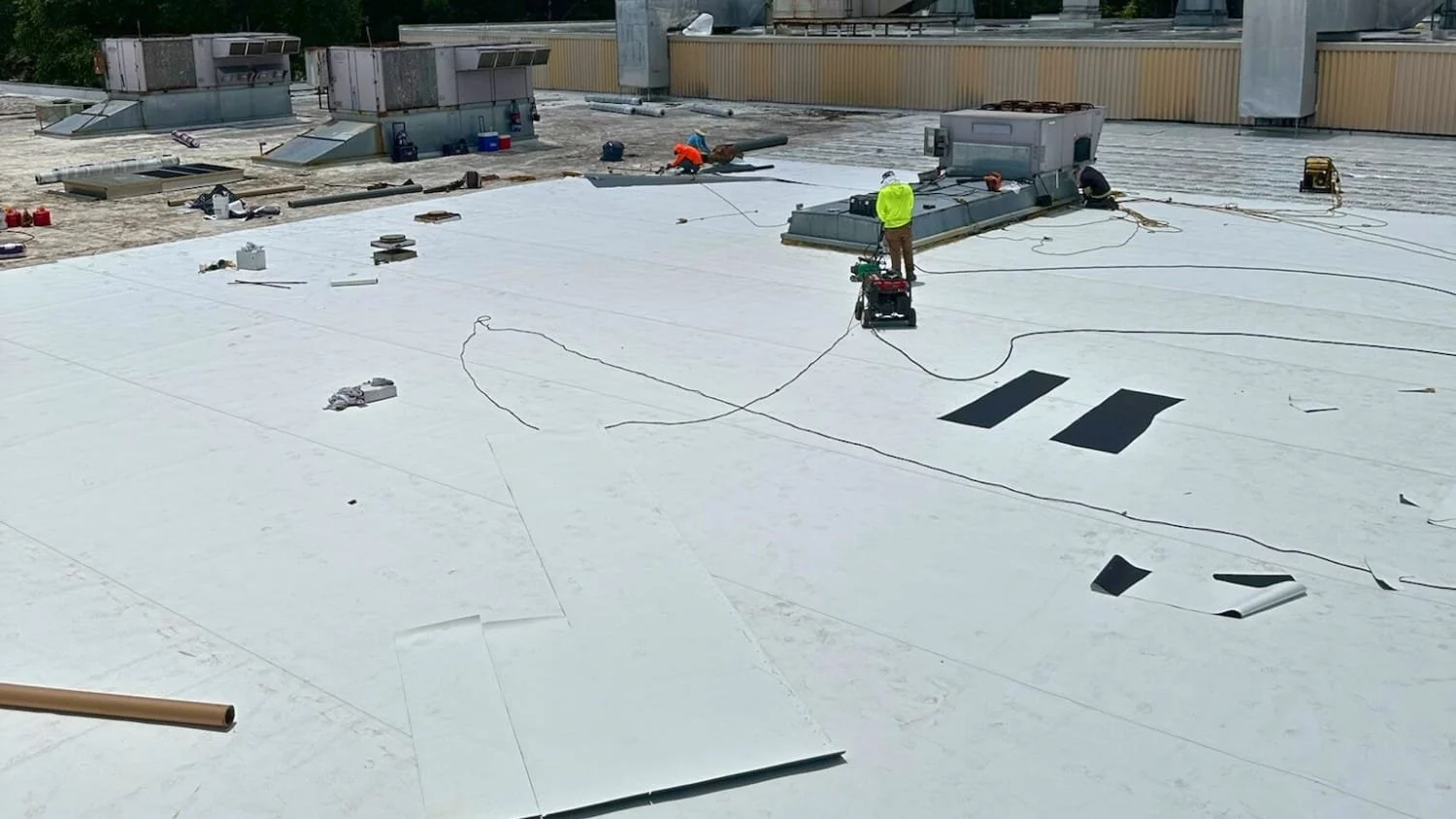
TPO Single-Ply Roofing for commercial buildings across Dayton, Montgomery County, Kettering, Beavercreek, Fairborn, Huber Heights, Vandalia, Miamisburg, Centerville, Springboro, Troy, Xenia, and the Miami Valley.
TPO — thermoplastic polyolefin — has become the dominant membrane specification for new low-slope commercial construction across Dayton's eastern suburbs and is the most frequently specified reroofing membrane in the broader Miami Valley market. The combination of heat-weldable seams that provide watertight joint integrity superior to adhesive-bonded systems, white reflective surface that meets Ohio's commercial energy code requirements, competitive installed cost relative to other single-ply options, and a robust manufacturer warranty program has made TPO the default choice for developers and building owners across Beavercreek, Fairborn, Washington Township, and the commercial corridors of the Centerville-Miamisburg corridor. Understanding where TPO performs optimally in Dayton's climate — and where its performance limitations require attention — is essential to getting the expected service life from the system.
UD Research Institute buildings and the newer institutional construction on the University of Dayton campus have been heavy adopters of TPO, particularly where white membrane reflectivity contributes to campus sustainability metrics and where heat-welded seam integrity is specified for buildings with rooftop equipment concentrations that create high maintenance traffic. The Ascent Industrial Park in Vandalia and its neighboring industrial developments along SR-48 represent another significant TPO concentration — newer flex industrial and distribution buildings specced with white 60-mil TPO as the baseline building specification. In Beavercreek's corporate corridors near SR-725 and on the newer construction along the I-675 technology corridor, TPO is the membrane specification that appears on virtually every low-slope commercial roof from the past 15 years.
Seam integrity is the performance parameter that defines TPO's real-world durability in Dayton's freeze-thaw climate. Heat-welded TPO seams — properly executed with calibrated hot-air welding equipment, correct welding temperature and speed, and adequate overlap width — produce a continuous factory-quality bond across the full seam width that is as strong as or stronger than the membrane field. These seams flex with the membrane through freeze-thaw cycling without delaminating, resist the shear stress of wind uplift at membrane perimeters, and maintain their integrity through the thermal expansion-contraction cycling that Dayton's temperature range produces. Improperly welded seams — welded at incorrect temperature, at insufficient speed, or with contaminated surfaces — fail at the precise conditions that Dayton's climate creates: cold contraction in January and uplift stress during summer storm events.
60-mil TPO versus 45-mil TPO is a specification decision that matters particularly for Dayton buildings with significant rooftop foot traffic. The 60-mil membrane provides meaningfully better puncture resistance and elongation performance than 45-mil — relevant for UD Research Institute buildings with high-density rooftop equipment and service personnel, and for industrial buildings in Ascent Industrial Park where HVAC maintenance activity crosses the roof surface regularly. The incremental cost difference between 45-mil and 60-mil TPO is relatively modest on a per-square-foot basis, and for buildings where trafficking is a realistic use condition, specifying 60-mil rather than the cheapest available specification is justified by the reduced risk of puncture damage over the warranty period.
TPO compatibility with existing membrane systems matters when TPO is being specified as part of a recover project over an aged EPDM or modified bitumen base. TPO seams must weld to TPO field membrane — they cannot be heat-welded to EPDM, modified bitumen, or BUR surfaces. When TPO is installed as a recover over an existing EPDM or modified bitumen system, a recovery board layer is installed between the existing membrane and the new TPO, providing the neutral substrate over which TPO field membrane and seams can be properly bonded. Contractors who attempt to skip the recovery board layer and weld TPO directly over existing non-TPO surfaces are creating a warranty-void installation that will fail at seams where the TPO bonds to an incompatible substrate rather than to itself.
Membrane manufacturer selection matters more with TPO than with EPDM, for a specific reason: TPO is a formulation, not a single chemistry standard. Different manufacturers use different polymer blends, antioxidant packages, and UV stabilizer systems in their TPO products. The long-term performance of TPO in Dayton's climate — particularly the membrane's oxidation resistance through years of UV and thermal cycling exposure — varies between manufacturer formulations. Specifying a TPO membrane from a manufacturer with a long performance track record in northern climate markets (ASHRAE Zone 5A and colder) and documented field performance data is more reliable than selecting based primarily on price. Building owners and architects specifying TPO for WPAFB contractor facilities, hospital campus projects, or other long-term institutional applications should evaluate manufacturer product history, not just current price and warranty terms.
White TPO reflectivity degrades over time primarily through surface soiling. Airborne particulates from I-75 and I-70 corridor industrial activity, bird droppings, and biological growth — algae and mold — gradually deposit on the white surface and reduce the membrane's initial solar reflectance. Studies of aged TPO in service show reflectance reduction from initial values (typically 0.70+) to aged values of 0.55 to 0.65 after five to ten years in service conditions. Periodic cleaning — a low-cost maintenance activity — restores reflectivity close to initial values. Building owners who are counting on specific energy performance from their white TPO system should include periodic cleaning in the maintenance program rather than assuming the initial reflectivity value is stable throughout the warranty period.
Wind uplift design for TPO in Dayton requires careful attention to the building's location and height in the context of ASCE 7 wind speed maps and exposure category classifications. Buildings in exposed locations — isolated industrial buildings in Vandalia, buildings at the edge of development on Dayton's suburban fringe, or taller office buildings in Beavercreek where there is no adjacent building shielding — experience higher effective wind pressures than buildings in urban arrays. The fastening pattern for mechanically attached TPO systems must be specifically designed for the project's wind uplift requirements, not selected from a generic table. FM or UL-approved fastening patterns with documented uplift ratings provide the calculation basis for code-compliant and warranty-compliant installations. Contractors who cannot provide the wind uplift calculation supporting their fastening pattern specification should not be trusted to design a reliable TPO installation on a Dayton commercial building.
What to send before the roof walk
Send the roof address, leak photos, roof age if known, access instructions, tenant limits, prior reports, and the deadline driving the decision. That lets the first visit focus on the roof condition instead of chasing basic context.
Questions Owners Ask
What's the expected lifespan of a TPO roof in Dayton?
A properly installed 60-mil TPO roof on a Dayton commercial building with appropriate seam welding quality and routine maintenance should achieve 20 to 25 years of service life. 45-mil systems may run 15 to 20 years depending on traffic and maintenance history. The primary life-limiting factors in Dayton's climate are seam delamination from poor initial welding quality, surface oxidation of the membrane field (manifesting as chalking and cracking), and flashing failures at penetrations and perimeters from freeze-thaw cycling. Manufacturer warranties of 15 to 20 years are available through certified contractor programs and provide some coverage assurance during the critical first half of the system's life.
Can I tell if my TPO seams are good without tearing them up to test?
Two non-destructive field tests are standard: visual inspection for seam appearance (uniform width, no edge burn, no voids or fish-mouths), and probe testing (running a blunt metal probe along the seam edge to detect any areas where the bond is incomplete or the edge is not fully welded). For important installations or when seam quality is in question, a limited number of destructive pull tests — cutting small samples of seam and testing bond strength in the field or laboratory — provide definitive quality data. Properly welded TPO seams fail in the membrane field during destructive testing rather than at the weld interface. Seams that peel apart at the weld interface during probe or pull testing are inadequately welded and should be repaired.
Why does my TPO roof have bubbles or blisters?
Blisters in TPO field membrane are typically caused by moisture trapped between the membrane and the substrate. On fully-adhered TPO systems, air and moisture pockets that develop after installation due to incomplete initial adhesive coverage can form blisters as temperature increases cause the trapped gases to expand. On mechanically fastened systems, blisters may indicate moisture accumulation beneath the membrane from substrate wet insulation. Small blisters that are not actively growing may be managed with monitoring rather than immediate repair. Large blisters, growing blisters, or blisters in field areas rather than limited to seam zones should be investigated to determine whether wet insulation is the underlying cause — an issue that affects the scope of any planned remediation work.
Is fully adhered TPO better than mechanically fastened in Dayton?
Fully adhered TPO has better wind uplift performance in exposed locations because the membrane is bonded continuously to the substrate rather than anchored at discrete fastener points. It also provides a cleaner appearance and slightly better thermal performance by eliminating the thermal bridging at fastener plate locations. Mechanically fastened TPO is faster to install, less sensitive to adhesive application conditions (a relevant consideration in Dayton's sometimes unpredictable weather windows), and more forgiving if the substrate has minor surface irregularities. For exposed buildings in Dayton's suburban and open industrial environments, fully adhered is the preferred specification. For buildings in protected urban locations or where cost is the primary constraint, mechanically fastened with proper uplift-calculated fastening patterns is appropriate.
What is the warranty process if my TPO roof fails before the warranty term?
Manufacturer warranties for TPO roofing are administered through the manufacturer's warranty service team and typically require a formal written claim submitted with photographic documentation of the failure condition and the project information (contractor, installation date, product specification). The manufacturer reviews the claim and determines whether the failure is covered under the warranty terms — which requires the failure to be a material or workmanship defect rather than damage from an external cause, abuse, or excluded conditions. Manufacturer warranty service teams are accessible through your roofing contractor or directly, and most major TPO manufacturers have responsive warranty service programs. Keeping your original warranty certificate, contractor completion documentation, and inspection records is important for warranty claim processing.