
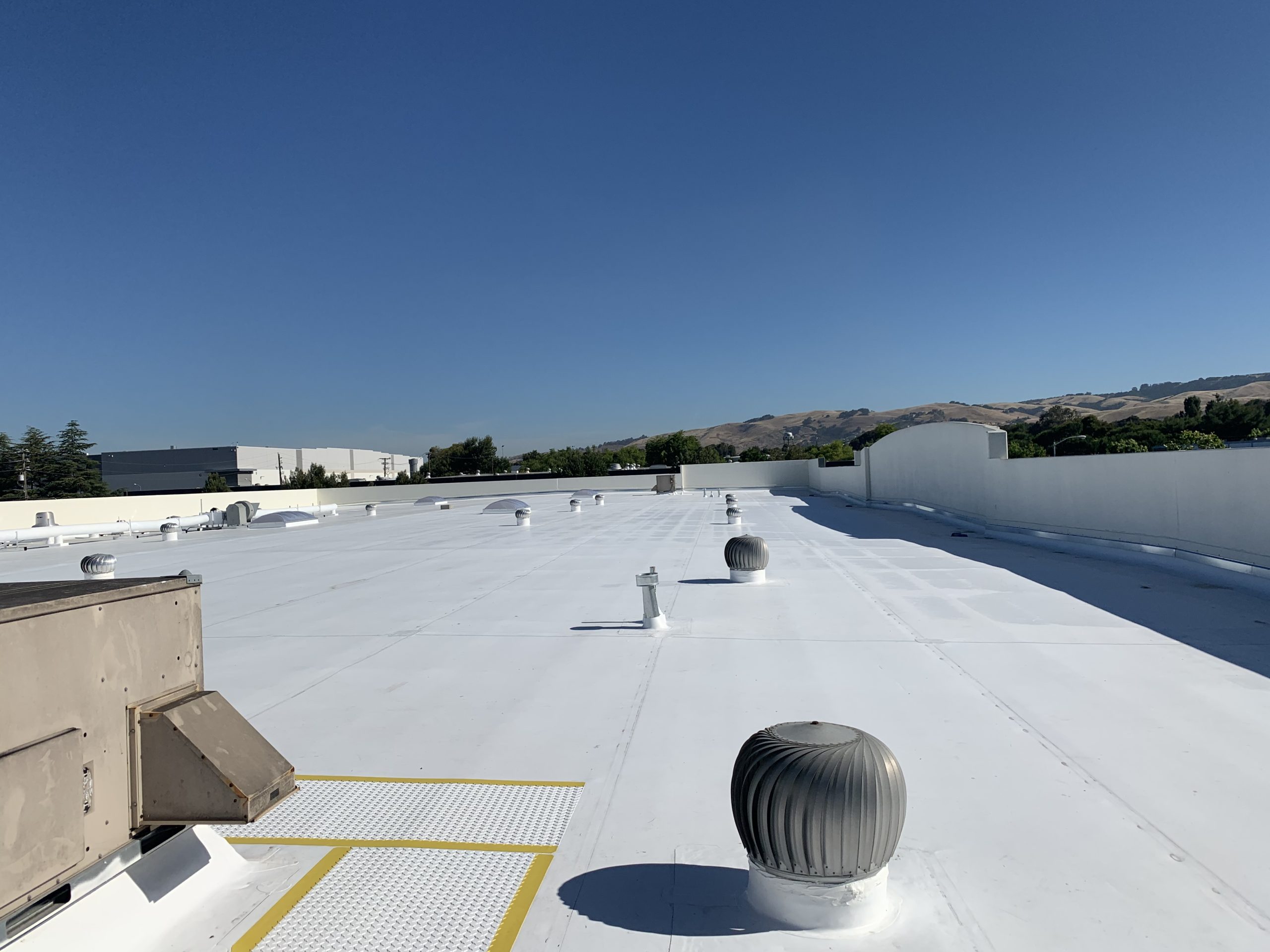
KEE Single-Ply Roofing for commercial buildings across Dayton, Montgomery County, Kettering, Beavercreek, Fairborn, Huber Heights, Vandalia, Miamisburg, Centerville, Springboro, Troy, Xenia, and the Miami Valley.
KEE — ketone ethylene ester — is the single-ply membrane chemistry that most building owners have never heard of but should know about if they manage an industrial, research, or defense contractor facility in the Dayton area. Where TPO dominates standard commercial new construction and EPDM occupies the reroofing-of-conventional-buildings niche, KEE membranes fill a specific performance category: chemical resistance combined with single-ply flexibility, heat-weldable seams, and long-term plasticizer stability that PVC — the other chemical-resistant single-ply option — can't always deliver over a 20-year service life in Dayton's climate.
UD Research Institute buildings on the University of Dayton campus present the kind of rooftop environment where KEE's chemical resistance properties become directly relevant. Research laboratories exhaust chemicals, solvents, and processing byproducts through rooftop ventilation systems. The membrane area around exhaust stacks and vent curbs on research buildings is regularly exposed to chemical concentrations that would degrade standard TPO or EPDM membrane surfaces over time. KEE membranes maintain their physical properties — flexibility, seam integrity, and UV resistance — under chemical exposure conditions that would cause premature degradation in standard single-ply products. The additional cost per square foot over standard TPO is justified on buildings where chemical exposure is a documented design condition.
Defense laboratories and engineering facilities near WPAFB in Fairborn and Beavercreek include a significant number of buildings with specialized rooftop equipment — testing rigs, communication arrays, environmental sampling equipment, and HVAC systems that exhaust research or manufacturing process air. The membrane around these rooftop systems experiences elevated chemical exposure that isn't always visible during routine inspection but accumulates over time. Facilities managers at defense contractor buildings who are evaluating reroofing options for buildings with significant rooftop process equipment should consider KEE as part of the membrane selection conversation, not just as a specialty product for the most extreme applications.
KEE's plasticizer stability is a key differentiator from PVC membranes in Dayton's climate. PVC membranes contain plasticizers that make them flexible at installation but can migrate out of the membrane over time — a process accelerated by heat cycles, UV exposure, and certain chemical exposures. As plasticizer migrates, PVC membranes become increasingly brittle and lose their cold-temperature flexibility. In Dayton's January temperatures, a plasticizer-depleted PVC membrane is vulnerable to cracking under the thermal contraction stresses that are routine for this climate zone. KEE membranes are formulated to maintain plasticizer stability throughout their service life, addressing the primary long-term performance concern that has led some specifiers to move away from PVC in northern climate markets.
Heat-welded seams are standard for KEE installation, as they are for TPO and PVC. The hot-air welding process for KEE membranes is similar to TPO welding with some differences in welding temperature and speed parameters that require trained operators. Quality seam welding on KEE — producing seams that achieve full membrane thickness bonding across the weld zone — depends on operator skill, equipment calibration, and ambient temperature and humidity conditions at time of installation. In Dayton's climate, KEE welding should be avoided when ambient temperatures are below 40°F without supplemental heating equipment, a constraint that effectively limits KEE installation to the May through October window for standard scheduling.
Rooftop equipment curb flashings on research and defense contractor buildings are among the most demanding details for any single-ply system, and KEE's flexibility and weldability make it well-suited to complex curb flashing geometry. When HVAC units sit on prefabricated curbs with multiple penetrations, drain connections, and equipment access panels, the flashing geometry around the curb base is intricate and requires a membrane that can be formed and welded at tight angles without cracking. KEE's cold-weather flexibility makes it a stronger performer in this application than products that become stiff and prone to cracking at lower temperatures — a practical advantage during the installation season and through the service life of the building in Dayton's winter conditions.
Long-term warranty terms for KEE systems are competitive with the best TPO and PVC warranty offerings, typically running 15 to 20 years with manufacturer-authorized contractor installation. The warranty structure for KEE typically requires certification through the membrane manufacturer's program, which limits the number of eligible contractors in the Dayton market compared to the broader installer base for commodity TPO products. Building owners specifying KEE should verify that their selected contractor is current in their manufacturer certification, as expired certifications can void warranty eligibility. For institutional and government facility owners who require a specific manufacturer warranty as part of their specification, verifying contractor certification status before execution is a standard pre-contract step.
Life-cycle cost comparison between KEE and standard TPO for a Dayton industrial or research facility should account for the chemical exposure context. In a standard office or retail building without chemical exposure, the additional cost of KEE over commodity TPO is hard to justify on performance grounds alone. In a building where rooftop chemical exposure is a documented condition, the comparison changes: a TPO or EPDM membrane that degrades prematurely due to chemical attack in year eight of a 20-year warranty creates replacement costs and operational disruption that far exceed the initial premium for a KEE system specified correctly from the start. The right membrane for a given Dayton building is the one that performs through the full design life under that building's actual operating conditions.
What to send before the roof walk
Send the roof address, leak photos, roof age if known, access instructions, tenant limits, prior reports, and the deadline driving the decision. That lets the first visit focus on the roof condition instead of chasing basic context.
Questions Owners Ask
What makes KEE different from standard PVC roofing?
KEE (ketone ethylene ester) and PVC share the characteristic of being heat-weldable single-ply membranes with good chemical resistance. The key difference is plasticizer formulation: PVC uses traditional plasticizers that can migrate out of the membrane over time, eventually causing brittleness and cold-temperature cracking. KEE uses a ketone ethylene ester polymer backbone that provides inherent flexibility without relying on migratable plasticizers. The result is a membrane that maintains its flexibility through a longer service life, particularly in climates like Dayton's where cold-temperature cycling is a regular stress condition.
Is KEE roofing cost-significantly more than TPO?
KEE membrane material costs are typically 20 to 35 percent higher than commodity TPO membrane on a per-square-foot basis. Installation labor costs are similar since the welding processes are comparable. On a project where chemical resistance is the driving specification requirement, the material premium is usually justified by the performance differential. On a project where chemical resistance is not a significant factor, standard TPO or EPDM typically provides better value. The premium is concentrated in the membrane material cost — insulation, cover board, and labor rates are similar across single-ply membrane types.
Which Dayton building types benefit most from KEE membrane?
Buildings with documented rooftop chemical exposure are the primary KEE candidates: research laboratories, pharmaceutical manufacturing, chemical processing facilities, defense testing environments with process exhaust, and commercial kitchen exhaust environments. UD Research Institute buildings, defense contractor engineering facilities in Beavercreek and Fairborn, and any Dayton industrial building where process exhaust is routed through rooftop systems are appropriate KEE candidates. Standard office, retail, warehouse, and industrial buildings without process exhaust are typically better served by standard TPO or EPDM systems at lower material cost.
Can KEE be installed over an existing roof system?
KEE can be installed as part of a recover assembly over existing roofing, subject to the same IBC two-layer maximum and moisture condition requirements that apply to all recover projects. The recovery board substrate under a KEE membrane must provide a smooth, compatible surface for adhesion where fully-adhered installation is specified, or must provide adequate bearing for the mechanical fastener and cover plate pattern in mechanically fastened installations. The chemical resistance benefit of KEE applies regardless of whether it's installed as a recover or as a full tear-off and replacement — the membrane performance is the same.
How are KEE seams inspected for quality?
Heat-welded KEE seams are inspected using a combination of visual inspection, probe testing, and in some cases destructive pull testing. Visual inspection checks for uniform weld width, consistent appearance, and absence of edge burn or under-weld conditions. Probe testing — running a blunt metal probe along the seam edge — checks for areas where the weld didn't achieve full bond. Destructive pull testing on cut samples verifies that seam bond strength meets specification — acceptable welds fail in the membrane field rather than at the weld interface. For large or institutionally important projects, seam testing documentation should be part of the project completion record.