
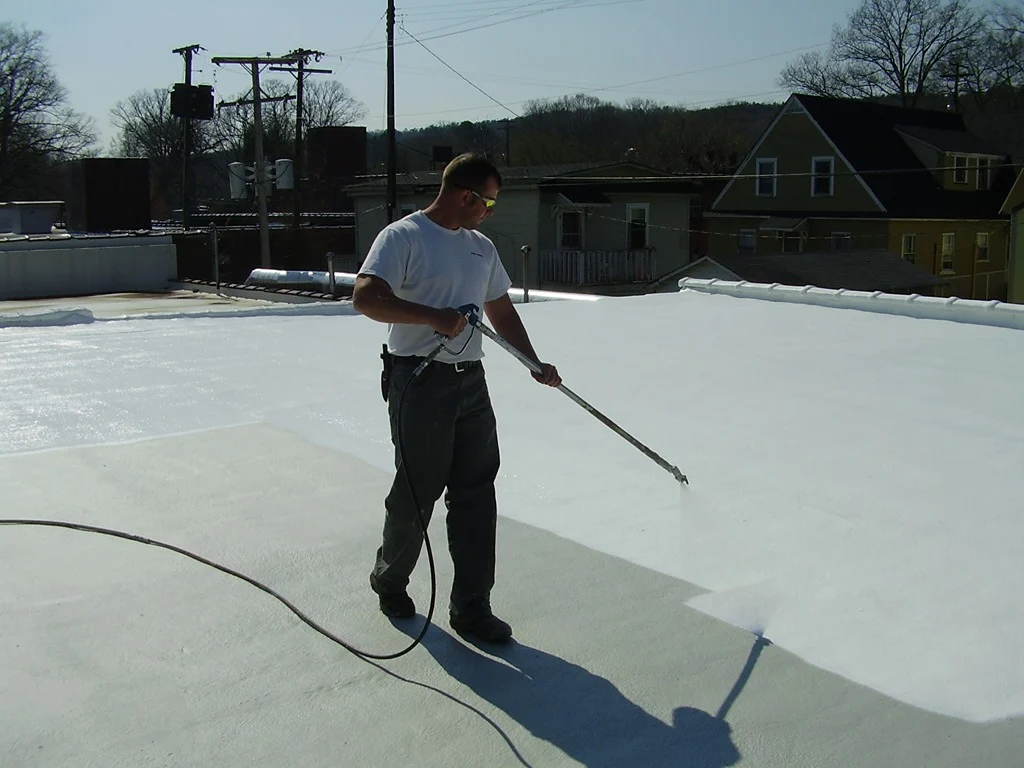
Spray Foam SPF Roofing for commercial buildings across Dayton, Montgomery County, Kettering, Beavercreek, Fairborn, Huber Heights, Vandalia, Miamisburg, Centerville, Springboro, Troy, Xenia, and the Miami Valley.
Spray polyurethane foam roofing solves problems that other systems can't address as efficiently — specifically, the sealing of complex, irregular metal building rooflines that would require extensive sheet metal fabrication and difficult membrane detailing with any other approach. The Moraine industrial corridor, Northwoods Industrial Park, and the miscellaneous metal building stock scattered through Montgomery County's industrial zones include a significant number of steel-framed buildings with standing seam or R-panel roofing that has developed widespread fastener backout, panel corrosion, or joint sealant failure. On these buildings, SPF applied directly over the cleaned metal surface fills every joint, seam, and fastener location simultaneously, creates a continuously bonded monolithic insulation-and-waterproofing layer, and eliminates the substrate compatibility issues that make other single-ply systems difficult on aged metal roofing.
Irregular rooflines are where SPF's application method — a two-component foam that expands and self-seals to the substrate surface after spray application — provides an advantage that no other roofing system can match. Where a metal building has a complex arrangement of HVAC curbs, pipe penetrations, low-profile skylights, translucent panels, and perimeter transitions at various heights and angles, SPF follows every contour and seals every transition without the need for separate fabricated flashing pieces at each change in geometry. This is particularly relevant for older Moraine and Northwoods industrial buildings that were constructed with minimal design attention to roof drainage geometry — SPF can be applied in variable thickness to create positive drainage slope toward drain locations, simultaneously improving drainage and waterproofing in a single application pass.
Application window management is the critical execution constraint for SPF roofing in Dayton's climate. Polyurethane foam chemistry requires substrate temperatures above 50°F and ambient relative humidity below 85 percent for proper foam cell formation and adhesion. Dayton's late spring and fall conditions — April through October — provide the best SPF application windows, with July and August offering the most consistent day-to-day temperature and humidity profiles for foam application. March and October are marginal months where morning temperature constraints frequently push start times to mid-morning and limit the productive work window. November through February is essentially a non-application period for SPF in the Miami Valley, which means any building requiring SPF roofing should be scheduled well before the first freeze to ensure the project can be completed before cold weather shuts down application.
The protective coating applied over SPF is the UV-protection and weather-resistance layer that determines the foam's long-term durability. Uncoated SPF foam degrades rapidly under UV exposure — the typical protection requirement calls for an elastomeric coating (silicone or acrylic) applied within 72 hours of foam application. In Dayton, where the spring and fall application windows can bring unpredictable weather patterns, coordinating the foam application and the coating application in the same weather window requires careful scheduling. A foam application that is left uncoated because a coating crew isn't available for several days after the foam day — a situation that occurs when contractors don't have integrated application crews — creates UV damage risk that must be addressed before the coating goes on.
SPF thickness specification affects both insulation performance and drainage slope correction. Standard SPF roofing is applied at a minimum of 1.5 inches thickness for basic waterproofing and insulation performance. For drainage slope correction — applying extra thickness on the upslope side of drainage zones to create positive slope toward drains — thickness may vary from 1.5 inches to 4 inches or more across a single roof area. Variable thickness SPF application requires an experienced operator who can control material output rate and lift thickness consistently while working across the full roof surface. Under-qualified SPF contractors who can't maintain consistent foam thickness create drainage problems and insulation voids that are invisible after coating but manifest as performance deficiencies throughout the system's life.
Re-coating frequency is the ongoing maintenance requirement that distinguishes SPF from most other commercial roofing systems. The elastomeric coating over SPF degrades through UV exposure and weathering, and must be refreshed periodically to maintain the foam's UV protection. Most SPF manufacturers recommend coating inspection every five years and re-coating when the coating shows significant erosion or loss of film thickness — typically every 7 to 15 years depending on coating type and application thickness. Silicone coating over SPF has better long-term UV resistance than acrylic coating and generally extends the re-coat interval. Building owners managing Moraine industrial buildings with SPF roofing need to include periodic re-coating in their capital plan rather than treating SPF as a permanently maintenance-free system.
Chemical compatibility considerations matter for SPF roofing on Dayton industrial buildings where process chemicals or exhaust compounds may contact the roof surface. Polyurethane foam and most elastomeric coatings have adequate resistance to the mild chemical exposures typical of general industrial environments. However, specific chemical compounds — strong solvents, concentrated acids, petroleum-based hydraulic fluids — can attack SPF foam or elastomeric coatings if contact is sustained. For Moraine industrial buildings where process chemistry creates specific rooftop exposure conditions, verifying coating chemistry compatibility with expected exposure compounds before specifying SPF is a standard due diligence step that prevents early coating failure at chemical contact zones.
New construction SPF applications in Dayton are less common than reroofing applications because TPO, EPDM, and modified bitumen systems are typically more cost-competitive on standard-geometry new construction. SPF's niche in the new construction segment is primarily in cold-storage and controlled-environment buildings where the continuous insulation-and-waterproofing single layer provides thermal bridge elimination and exceptional air sealing — properties relevant to some WPAFB contractor facility types and research buildings at UD. For general commercial construction in Beavercreek, Fairborn, or the Washington Township commercial corridor, standard single-ply systems are typically selected over SPF on cost and familiarity grounds. SPF is most likely to be specified when the specific building conditions — irregular geometry, drainage correction needs, or controlled-environment thermal performance requirements — make it the technically superior solution rather than a generic alternative.
What to send before the roof walk
Send the roof address, leak photos, roof age if known, access instructions, tenant limits, prior reports, and the deadline driving the decision. That lets the first visit focus on the roof condition instead of chasing basic context.
Questions Owners Ask
What makes spray foam roofing a good choice for metal buildings in Dayton?
Metal building roofing in Dayton's freeze-thaw climate develops widespread fastener backout, sealant failure at panel joints and ridge caps, and edge-condition corrosion that makes traditional repair approaches progressively more expensive as the building ages. SPF applied over a cleaned metal building roof fills every joint and seam in a single application, creates a continuous waterproofing and insulation layer that eliminates the individual leak points that characterize aging metal roofing, and can be applied in variable thickness to improve drainage slope. For metal buildings in Moraine and Northwoods Industrial Park that have reached the chronic repair stage, SPF is often the lowest total cost solution when the accumulated repair costs and disruption of reactive maintenance are factored into the comparison.
How long does spray foam roofing last in Dayton?
A properly applied and maintained SPF roofing system can last 30 to 50 years in Dayton's climate — longer than most single-ply membrane systems. The key to achieving this longevity is the re-coating program: the foam itself is extremely durable and does not degrade through freeze-thaw cycling or UV exposure when protected by its coating layer, but that coating layer must be maintained. A building with an SPF system that is systematically re-coated on schedule — typically every 10 to 15 years — has a roofing system with no practical end-of-life. SPF's longevity advantage over conventional systems is most clearly realized when the re-coating obligation is built into the long-term capital plan from the outset.
Can spray foam be applied directly over my existing R-panel roof?
Yes — SPF can be applied directly over existing R-panel and standing seam metal roofing, which is one of its primary applications in the Dayton industrial market. The existing metal surface must be thoroughly cleaned of debris, corrosion products, oil contamination, and loose paint before foam application. Any structural corrosion in the metal panels that affects their integrity as a substrate for the SPF must be addressed before application. The foam bonds directly to the cleaned metal surface and fills all panel ribs, fastener locations, and joint conditions. No recovery board or separate substrate preparation layer is required, which is a significant installation efficiency advantage over other roofing systems in the metal building reroofing context.
What's the R-value of spray foam roofing?
Closed-cell spray polyurethane foam — the type used in roofing applications — provides approximately R-6.5 per inch of thickness. At the standard 1.5-inch minimum thickness, SPF provides approximately R-9.75, which is supplemented by any existing insulation beneath the metal deck. For Dayton buildings where energy code compliance requires specific minimum R-values, SPF thickness can be increased to achieve the required performance — and the variable thickness used for drainage slope correction automatically increases the average insulation value above the minimum. The combination of air sealing and insulation in a single application layer is particularly valuable for metal buildings in Dayton that lack a separate air barrier layer below the roof deck.
Is spray foam roofing flammable — is there a fire concern?
Polyurethane foam is combustible and requires the protective coating not just for UV resistance but also for fire resistance purposes. Uncoated SPF foam that is exposed to flame will burn. The protective elastomeric coating applied over the foam provides the necessary Class A fire rating when the coating is applied at the required thickness and the system is tested and listed to UL or FM standards. Building owners should verify that their SPF contractor is using a complete system — foam plus coating — that has been tested and listed to the required fire rating for commercial occupancy. Roofing SPF systems with code-required coatings at appropriate thickness are acceptable for commercial applications in Ohio when installed according to the listed system requirements.