
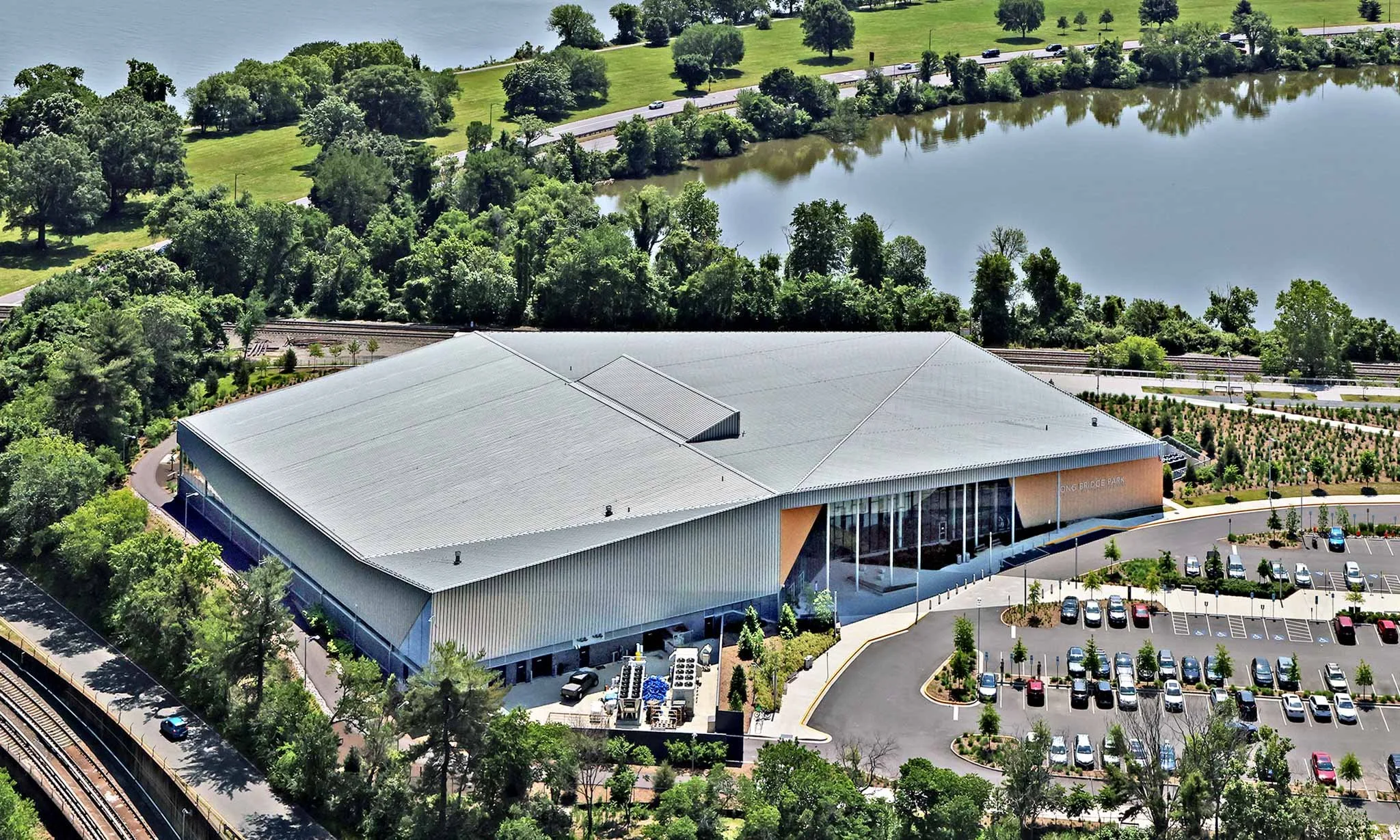
Wide-open spans, heavy rooftop HVAC, and pool humidity that attacks the assembly from below. We design the roof for the moisture the building makes, not just the rain it sheds.
The threat to a gym roof comes from inside
Most commercial roofs fight water that lands on top of them. A fitness facility roof fights water it generates underneath. Showers running from open to close, a lap pool or therapy spa holding warm water all day, steam rooms, and a training floor packed with breathing, sweating members all push warm, saturated air up against the deck. If that vapor reaches a cold surface inside the assembly, it condenses, soaks the insulation, and rots the roof from the bottom while the membrane on top still looks fine. We treat the vapor drive in a Dayton gym as the primary design problem, which is the opposite of how a standard retail roof gets specified.
The clubs we work on sit across the region's busiest fitness submarkets. The big-box clubs anchoring centers near the Dayton Mall and along the Miamisburg-Centerville Road retail spine, the studios and CrossFit boxes filling adaptive-reuse bays in the Oregon District and along Brown Street near the University of Dayton, and the membership clubs out toward Beavercreek and the Mall at Fairfield Commons all share the same physics. A college-adjacent location near UD runs at near-capacity through the school year, which only raises the occupancy moisture load the roof has to manage.
Long clear spans the membrane has to follow
A basketball court, a turf training bay, or a group-fitness room means a roof deck that crosses a wide span with no columns underneath. Those decks flex. A fastening pattern copied from a strip-mall roof concentrates load at the seams and works the membrane loose over a span that moves. We verify the deck type, gauge, and rib depth and pull-test fastener values before we commit to an attachment method, and on the longer spans we will move to an adhered or hybrid system to keep point loads off a deck that deflects under a full house.
Rooftop equipment, counted one curb at a time
High occupancy means high air volume. A training floor needs aggressive ventilation to hold carbon dioxide and humidity down, locker rooms and pool enclosures carry dedicated exhaust, and a club with a pool runs a specialized dehumidification unit that is among the largest pieces of equipment on the roof. The penetration count per thousand square feet on a gym easily runs double a comparable office. Standard pipe-boot and curb details are not adequate for the humidity these buildings throw at them, so every curb gets sized, flashed, and documented as its own line item.
- Dedicated pool dehumidification units with large supply and return curbs that must be flashed for both weather and interior vapor.
- Locker-room and steam-room exhaust fans venting the wettest air in the building straight through the roof.
- Make-up air units feeding the open training floor, often retrofit onto curbs never sized for them.
- Refrigerant and condensate lines crossing the field that need walkway protection from service crews.
Building the assembly for a natatorium
For clubs with a pool or spa we specify a fully adhered 60-mil TPO or PVC over a correctly positioned vapor retarder. Adhering the membrane removes the fastener field that mechanical attachment drives straight through the assembly, and getting the vapor retarder on the right plane for Ohio's climate zone is what keeps interior moisture from condensing inside the insulation. Put that retarder in the wrong place and the R-value collapses within a few seasons regardless of how clean the top-side workmanship is. For a dry facility with no pool, a mechanically attached 60-mil TPO is appropriate and far more economical, and we will tell you which building you have rather than upselling the membrane.
Roofing a building that almost never closes
Plenty of Dayton clubs run from before dawn until after midnight, and the 24-hour locations never lock the door at all. There is no convenient overnight window, so we coordinate the schedule with the club's facilities contact before we mobilize, confirm each day's tear-off and dry-in in writing, and give the manager a daily status so they can confirm the roof is watertight before the next wave of members arrives. Noise limits over occupied locker rooms and crew start times go into the pre-construction plan, not into a change order after someone complains.
Curbs that no longer meet warranty
Older gym buildings are full of rooftop units sitting on curbs that have sunk below the height the membrane manufacturer requires for warranty. Raising or rebuilding those curbs is standard scope on our fitness projects, because a new membrane flashed to an undersized curb is a warranty rejection waiting to happen.
Closeout for chains and independents alike
National operators run their own vendor-approval and facilities-management systems, and we work inside those for branded locations while dealing directly with independent owners and the real estate investors who hold the buildings. Either way the closeout package is the same: the building permit and final inspection certificate, manufacturer warranty registration, a roof-zone diagram with the full penetration inventory, a drain and flashing inspection record, and photo documentation of every detail. Chain accounts get it formatted to match their corporate system.
The leak that is really condensation
The trickiest call on a gym roof is telling a real leak from interior condensation, because they look identical from the locker-room ceiling. A drip after a hard rain points one direction; a drip that shows up on a cold January morning with no rain in the forecast points to vapor condensing inside the assembly instead. Misread it and you tear off a sound membrane to chase a problem the membrane was never causing. We diagnose the difference before recommending a scope — checking the vapor retarder, surveying for saturated insulation, and correlating the staining with weather and pool-area operation — so the fix addresses the actual mechanism rather than the symptom.
Staying ahead of a humid roof in an Ohio winter
The Miami Valley winter is exactly when a gym roof is most stressed: the building is throwing off the most interior moisture while the deck above is at its coldest, which is the textbook recipe for condensation inside the assembly. Add the freeze-thaw cycle working at every curb the dense rooftop equipment created, and small problems compound fast. A semiannual maintenance routine that clears the drains, reseals the high count of exhaust and dehumidifier-unit flashings, and verifies the walkway pads are protecting the membrane from constant service traffic is cheap insurance on a building that runs every day of the year. We would rather catch a tired pipe boot in October than a stained ceiling over the pool deck in February.
If you operate a club or own the building one leases, and the roof has not been looked at since the last membership push, request a roof review and we will tell you what the humidity is doing to it.
What to send before the roof walk
Send the roof address, leak photos, roof age if known, access instructions, tenant limits, prior reports, and the deadline driving the decision. That lets the first visit focus on the roof condition instead of chasing basic context.
Questions Owners Ask
Can this work happen while the building is occupied?
Often yes. The scope should cover access, safety, dry-in, staging, noise, interior protection, and the times when tenants or operations cannot be interrupted.
What changes the cost most?
Wet insulation, deck condition, edge metal, layer count, access, roof size, code triggers, weather timing, and the amount of repeated damage usually move the cost.
How is the condition documented?
The roof file should include photos, locations, material notes, observed defects, temporary repairs, remaining deficiencies, and recommended next steps.