
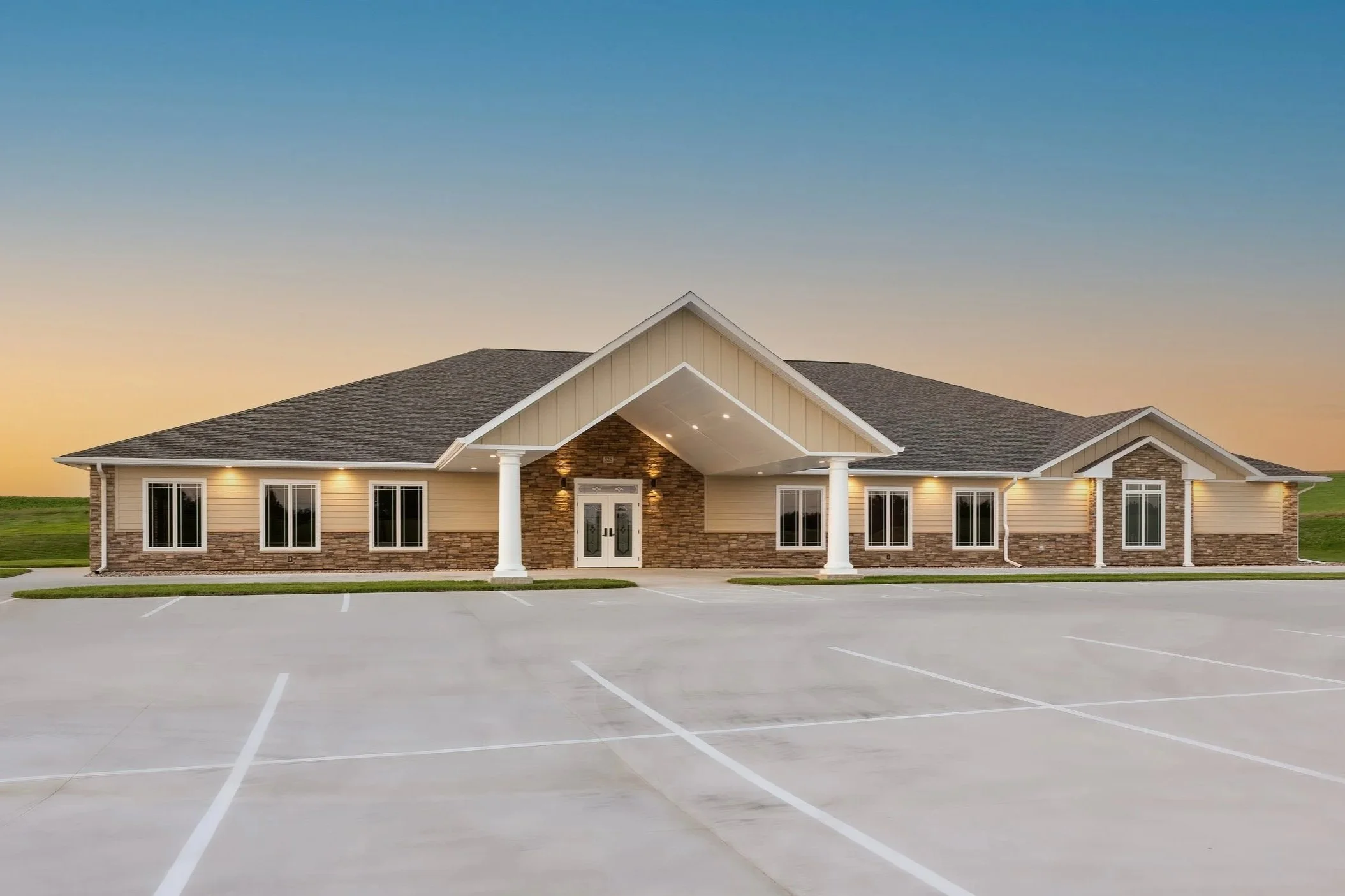
A Roof Project Families Should Never Notice
A funeral home is never really empty. Visitations run into the evening across the week, services can fill the building on short notice, and the preparation areas operate on a schedule set by death calls rather than anyone's construction plan. That means roofing work here has to be quiet, clean, and almost invisible to the families who are walking in on the hardest day of their lives. We bring the same occupied-building discipline to a funeral home that we bring to a hospital or a nursing home, and across Dayton's established neighborhoods — the older funeral homes anchored along North Main Street and the Salem Avenue corridor, the family-run chapels serving Kettering, Oakwood, and Huber Heights, and the regional chain locations near the suburban arterials — that discretion is the whole job.
Appearance carries weight on these buildings in a way it does not on a warehouse. A funeral home's exterior is part of how families judge whether the place will treat them with care, so a stained fascia, a sagging gutter, or a patchy roofline reads as neglect. When we work on one, we plan the visible details — edge metal, coping, gutters, the entry canopy — so the finished building looks composed and dignified, not like a job site that wrapped up in a hurry.
The Preparation Room Exhaust Cannot Go Down
The embalming and preparation area is the one part of a funeral home roof that allows no improvisation. These rooms run under negative pressure to contain formaldehyde and other chemical vapors, and the rooftop exhaust serving them has to keep operating continuously to stay within OSHA requirements. We locate that exhaust stack before we mobilize, treat the flashing around it as its own scope item handled with the funeral director's approval, and confirm the exhaust stays running during any work close to it. That stack is never capped, blocked, or taken offline for our convenience — we work around it while it keeps doing its job.
The chapel and visitation rooms are often clear-span spaces, 40 to 60 feet across with no columns in the middle, much like a small church sanctuary. Those spans generate real wind-uplift loads and need a fastening pattern and membrane specification matched to the deck and span, not a generic flat-roof detail. We evaluate the deck type and the existing attachment, and on long-span steel or wood decks we confirm the attachment design with pull-out testing or structural documentation before specifying the system.
Older Buildings Hide Wet Roofs
Many Dayton funeral homes occupy buildings that have been added onto over decades, and the roofs reflect that — multiple membrane generations, built-up roofing over wood or concrete decks, and drainage that was never quite right. The recurring trap on these is wet insulation hidden under a surface membrane that still looks serviceable from the ground. Before we recommend a recover, we core and run a moisture survey, because sealing a new membrane over saturated insulation just buries the problem and corrodes the deck underneath. On wood-decked chapel roofs we confirm load capacity before settling on insulation thickness, and where the existing drainage ponds water we use tapered insulation to move it to scuppers or drains.
The Porte-Cochere and Covered Entry
Almost every funeral home has a porte-cochere or covered entry where families are received out of the weather, and the spot where that canopy ties into the main building is one of the most common chronic leaks we trace on these properties. The canopy membrane or panels, the gutters and downspouts, and that canopy-to-building transition flashing are all evaluated as part of the roof scope rather than left for later, because a drip over the entry is exactly where you do not want one.
Steep-Slope, Slate, and Mixed Roofs on Heritage Buildings
A lot of Dayton's older funeral homes are converted residences or purpose-built chapels with steep-slope sections — slate, tile, dimensional shingle, or standing-seam metal over the public-facing parts of the building, with low-slope membrane hidden behind a parapet or over the rear additions. These mixed roofs are where leaks hide, because the transition from a steep section down to a flat one, and the valleys and the chimney and dormer flashings on the visible slopes, are the details that fail first and read worst from the curb. We evaluate the whole roof as one system rather than just the easy flat field, match repair or replacement materials to what is already there so the building keeps its character, and treat the slope-to-flat transitions as deliberate flashing details instead of a seam someone slathered with sealant and hoped for the best.
Interior Finishes Are Unforgiving Here
The cost of a small leak is higher in a funeral home than in almost any other small commercial building, because the interiors are finished to a standard families are meant to find comforting — plaster ceilings, wood trim, fabric and upholstered furnishings, and lighting that all stain and warp the moment water touches them. A drip that would be a shrug in a warehouse can close a viewing room and force a family to be relocated mid-service. That reality is why we are conservative about leak-tightness on these buildings: generous flashing heights, redundant detailing at every penetration, and a moisture survey that catches a problem before it reaches the ceiling rather than after. Protecting the finishes below is as much the point of the job as protecting the structure.
Quiet Scheduling, Start to Finish
We build the work sequence around the funeral director's calendar. With advance notice of scheduled services and visitations, we keep active service areas protected and free of construction noise during those hours, stay out of the main entry and chapel spaces while families are present, and confirm the building is watertight before it closes each evening. Whether you operate a single family-owned chapel or a location within a regional group, the experience for the families inside should be the same: they never know we were there.
- Work sequenced around the service and visitation calendar, with no noise or disruption during services
- Preparation-room exhaust kept running continuously, with flashing handled as a separate detail
- Clear-span chapel roofs detailed for uplift, with attachment confirmed on the actual deck
- Moisture survey and coring before any recover on older multi-generation buildings
- Porte-cochere, canopy, and entry-transition flashing addressed within the scope
- Dignified attention to edge metal, coping, and gutters so the exterior reads as cared-for
If you manage a funeral home or mortuary anywhere in the Dayton area, reach out and we will arrange a roof review at a time that fits around your services, walk the building discreetly, and give you a scope geared to quiet scheduling and a dignified result.
What to send before the roof walk
Send the roof address, leak photos, roof age if known, access instructions, tenant limits, prior reports, and the deadline driving the decision. That lets the first visit focus on the roof condition instead of chasing basic context.
Questions Owners Ask
Can this work happen while the building is occupied?
Often yes. The scope should cover access, safety, dry-in, staging, noise, interior protection, and the times when tenants or operations cannot be interrupted.
What changes the cost most?
Wet insulation, deck condition, edge metal, layer count, access, roof size, code triggers, weather timing, and the amount of repeated damage usually move the cost.
How is the condition documented?
The roof file should include photos, locations, material notes, observed defects, temporary repairs, remaining deficiencies, and recommended next steps.