
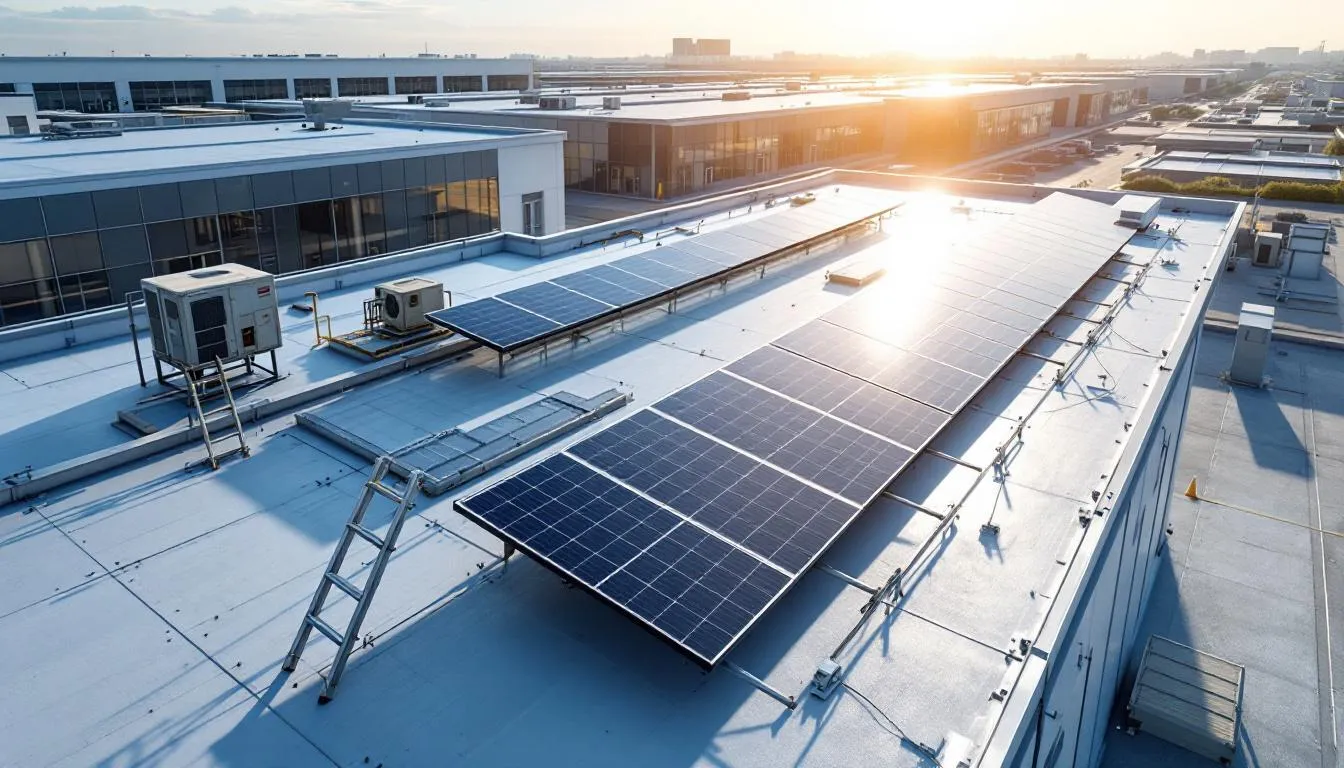
Multi-tenant low-slope roofs full of penetrations, reworked every lease cycle. We survey what is actually up there before we price a single square.
A roof that changes every time a tenant does
Flex space is the chameleon of the commercial inventory. The same shell that held a tool-and-die shop in 2008 might house a third-party logistics operator, a brewery taproom, and a contractor's parts counter today, with each suite carved out behind its own demising wall. Every one of those moves left a mark on the roof. New rooftop units got set, old curbs got abandoned, condensate lines got run across the membrane, and somewhere a satellite dish got bolted through 60-mil TPO with a tube of hardware-store sealant. We do not start an industrial flex project in Dayton by quoting a square-foot price. We start by walking the deck and mapping what is actually penetrating it, because the building records almost never match reality.
Around Dayton, this building type clusters where freight access and cheap clear-span square footage meet. The flex and light-industrial corridors along Springboro Pike and the Miami Valley Research Park near Kettering, the older bays off Webster Street and the North Dixie Drive frontage, and the newer tilt-up product near the Dayton International Airport logistics hub off Union Road all carry inventory that trades between uses constantly. A landlord buying into that market is buying a roof history written by a dozen prior tenants, and the leaks usually trace back to their improvements rather than to the original membrane.
Why penetration density is the whole story
A single-user warehouse might run a handful of roof penetrations across an acre of membrane. A multi-tenant flex building of the same footprint can carry two or three times that count, because every suite wants its own rooftop heating and cooling, its own exhaust, and its own power and data drops. Each one is a flashing detail that can fail independently, and on a roof that has been modified piecemeal over fifteen years, the original installer's warranty details rarely survived the tenant churn intact.
- Abandoned curbs left after a rooftop unit was pulled, capped with sheet metal that telegraphs every freeze-thaw cycle until it splits.
- Condensate and refrigerant lines laid directly on the membrane with no walkway protection, wearing a groove into the sheet.
- Tenant-added gas piping and conduit on unsealed pipe boots that dried out two summers ago.
- Demising-wall lines below that create interior pressure differences, pushing humid air up into the assembly at the worst seams.
Specifying the reroof for the building you actually have
Flex buildings in this region split roughly into two construction eras, and each takes a different system. The 1970s and 1980s tilt-wall and block buildings usually carry a tired built-up or ballasted assembly over steel deck; for those we typically specify a 60-mil mechanically attached TPO over new tapered polyiso, which corrects the drainage that two decades of ponding wore flat. Where tenant traffic from HVAC service crews is heavy, we move up to an 80-mil sheet or a fully adhered PVC to buy puncture and grease resistance. The pre-engineered metal buildings going up near the airport logistics zone are a different animal entirely — there a coated-metal restoration or a retrofit standing-seam recover often outperforms a tear-off, depending on panel condition and purlin spacing.
Before any of that is priced, we cut cores. A flex roof that has been recovered once already, or that hides saturated insulation under a deceptively dry-looking surface, changes the entire scope and the weight-in-place calculation. Guessing here is how a recover bid turns into a tear-off change order halfway through the job, and we would rather find the surprise with a knife than with an invoice.
Working around tenants who do not share a schedule
The hardest part of flex roofing is rarely the membrane — it is the people underneath it. A logistics tenant ships at 4 a.m., the taproom opens at noon, and the machine shop runs dust collection that cannot lose power. We build the sequence off a bay-by-bay occupancy map from property management, identify which suites have live rooftop equipment and which are dark, and run all tenant communication through the property manager rather than fielding calls from a dozen separate businesses. No section of roof gets opened that will not be dried in and watertight before that tenant's next operating window.
Dark bays are where flex roofs quietly fail. When a tenant leaves and their rooftop unit comes off, the opening gets a temporary cap that the next hard rain finds. Debris piles up over drains that nobody is watching because no one is paying rent below. Our lease-transition inspections confirm curb-cap status, verify that the departed tenant's penetrations are properly sealed, and clear the drains before the empty suite becomes a claim against the next lease.
Finding which tenant's penetration is leaking
On a multi-tenant flex roof, a leak reported in suite C did not necessarily start over suite C. Water enters at a failed boot or a cracked curb cap, runs along the steel deck flutes or a seam, and surfaces wherever the assembly lets it down — often a bay or two away, over a tenant who never touched the roof. That is why we do not chase the stain. We isolate roof zones, map the leak against the penetration inventory from the survey, and use moisture scanning to find saturated insulation that has not yet dripped. On a building where a wrongly blamed tenant means a lease dispute, pinning down the true entry point is as much about keeping the rent roll intact as it is about the repair.
Freeze-thaw versus a roof full of penetrations
The Miami Valley freeze-thaw cycle is hard on any low-slope roof, and a flex roof gives it the most targets. Every abandoned curb cap, every dried-out pipe boot, and every seam around a tenant-added penetration is a place where water can pool, freeze, expand, and pry the detail open a little more each night. A flex roof with two decades of undocumented modifications can carry dozens of these vulnerable points. A practical semiannual maintenance routine — clearing the drains the vacant bays let clog, resealing aging boots, and re-checking the capped openings before winter — costs a fraction of an emergency call and keeps the small failures from compounding into a tear-off the owner did not budget for.
Reporting built for owners and asset managers
Most of the flex roofs we touch belong to investors and property managers running more than one building. We price per roofing square against a documented condition assessment, deliver fixed-price proposals after the walk and cores, and format the closeout so it drops straight into a capital plan — permit records, manufacturer warranty registration, a drain and flashing inspection record, and a roof-zone diagram with the full penetration inventory. For a portfolio, that standardized report is what lets you compare the roof on North Dixie against the one out by the airport and decide which one gets the budget this year.
If you own or manage flex space anywhere across the Miami Valley and the roof history is a mystery, we will come survey it and tell you plainly what you are working with. Request a roof review and we will start with the deck, not a template.
What to send before the roof walk
Send the roof address, leak photos, roof age if known, access instructions, tenant limits, prior reports, and the deadline driving the decision. That lets the first visit focus on the roof condition instead of chasing basic context.
Questions Owners Ask
Can this work happen while the building is occupied?
Often yes. The scope should cover access, safety, dry-in, staging, noise, interior protection, and the times when tenants or operations cannot be interrupted.
What changes the cost most?
Wet insulation, deck condition, edge metal, layer count, access, roof size, code triggers, weather timing, and the amount of repeated damage usually move the cost.
How is the condition documented?
The roof file should include photos, locations, material notes, observed defects, temporary repairs, remaining deficiencies, and recommended next steps.