
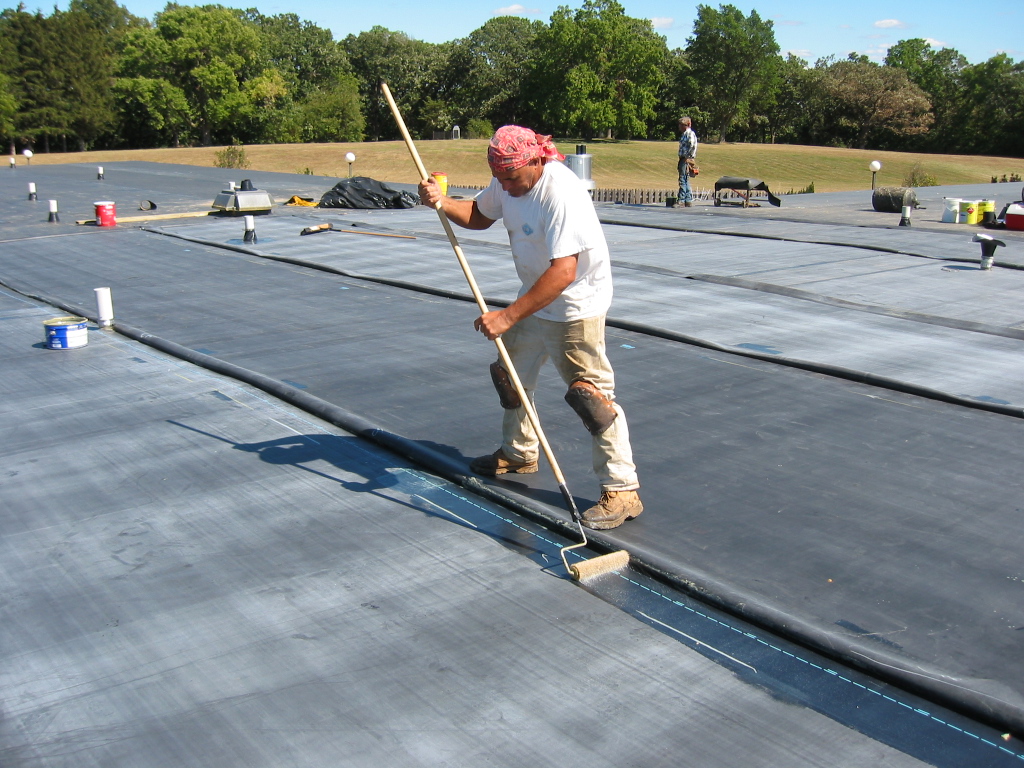
EPDM Roofing for commercial buildings across Dayton, Montgomery County, Kettering, Beavercreek, Fairborn, Huber Heights, Vandalia, Miamisburg, Centerville, Springboro, Troy, Xenia, and the Miami Valley.
EPDM — ethylene propylene diene monomer — has been the workhorse single-ply membrane across Dayton's commercial and institutional building stock for four decades. University of Dayton campus buildings, older commercial structures throughout Kettering and Moraine, and the building inventory of Dayton's industrial corridors accumulated EPDM as the preferred reroofing material from the 1980s through the 2000s. That installed base is now aging, and a significant portion of the EPDM on Dayton commercial roofs is entering or past the back half of its expected service life — making recover-versus-tear-off decisions a recurring capital planning question for facilities managers across the Miami Valley.
Freeze-thaw cycling is EPDM's principal climate challenge in Dayton. The material itself remains flexible at temperatures well below freezing — EPDM's elasticity at -40°F is one of its genuine performance advantages — but the adhesives and seam tapes used in EPDM installation do not age as gracefully through repeated thermal cycling. Lap seam adhesive on older fully-adhered EPDM systems gradually loses bonding strength through the expansion-contraction cycle that Dayton buildings experience from November through March. Seam adhesive that was fully bonded in year three begins showing edge delamination by year twelve, and those delaminated seam edges are the primary water infiltration pathway in aging EPDM systems across Montgomery County.
The recover-versus-tear-off decision for EPDM on Dayton industrial and commercial buildings is fundamentally a moisture question. IBC allows a maximum of two roofing layers, so buildings that have already been recovered once require a full tear-off. But even for buildings still in their first layer, the decision depends on the moisture content of the existing insulation. Dayton's freeze-thaw cycle allows water that infiltrates through a compromised seam or flashing to migrate laterally through the insulation board layer — a pinhole infiltration in October can produce a wet insulation area the size of a conference room by March. Recovering a roof with significant wet insulation traps that moisture permanently and creates ongoing vapor pressure that destabilizes the new membrane from below.
Moraine's industrial corridor and the Kettering commercial district have a high concentration of buildings in the 40,000 to 150,000 square foot range with EPDM systems installed between 1985 and 2005 — precisely the age range where comprehensive moisture surveys are most valuable before any capital roofing decision. Infrared thermographic scanning of these buildings typically reveals wet insulation patterns concentrated around HVAC equipment curbs, drain perimeters, and the perimeter flashing zone — the areas where age-related adhesive and sealant failure is most common. Buildings in this category should not skip the moisture survey step and move directly to recover specifications without knowing whether tear-off is actually the more appropriate scope.
New EPDM installation in the Dayton market remains viable and appropriate for many building types. Fully-adhered EPDM continues to be specified for reroofing applications where the substrate geometry is complex — multiple level changes, extensive penetrations, or irregular shapes — because EPDM's flexibility makes field detailing easier than thermoplastic membranes that require hot-air welding. Mechanically fastened EPDM is common in recover applications over existing assemblies where full adhesion is impractical. Ballasted EPDM — held in place by river rock or concrete pavers — is less common in new construction today due to seismic weight considerations and building code updates, but still found in reroofing applications on structures with sufficient structural capacity.
UD campus buildings present a specialized EPDM maintenance context. The University of Dayton manages a large and varied building inventory, and its facilities management department maintains ongoing service relationships with commercial roofing contractors for routine maintenance and repair. EPDM on university campus buildings often shows damage patterns related to high foot traffic from maintenance personnel — antenna crews, HVAC technicians, and other trades who cross the roof surface regularly without following established walkway routes. Surface punctures and seam damage from trades traffic is a leading cause of premature leak development on otherwise sound university building roofs, and adding walkway pad systems along established access routes is a practical mitigation.
Flashing durability on EPDM systems in Dayton's climate deserves specific attention at inspection time. Pipe boot flashings — the conical rubber boots that seal around pipe penetrations — are typically made from EPDM-compatible rubber that becomes brittle and cracks with UV exposure and thermal cycling over time. On buildings installed before 2005, original pipe boots are frequently the first components to fail even when the field membrane is still sound. Parapet wall flashings terminating under metal counterflashing can wick water if the counterflashing becomes elevated or detached through freeze-thaw movement. These flashing conditions are among the most common active leak sources on Dayton EPDM roofs that are otherwise in serviceable condition.
Manufacturer warranties for EPDM systems require installation by certified contractors using approved materials, and warranty terms vary significantly between manufacturers and installation methods. Fully-adhered systems typically carry longer warranties than mechanically fastened systems. Seam width requirements, primer application standards, and termination detail specifications all affect warranty validity. Building owners managing EPDM-roofed properties in Dayton should verify whether their existing system is under an active manufacturer warranty and what inspection or re-registration requirements apply to keep that warranty current — a question that is frequently not asked until a claim situation arises.
What to send before the roof walk
Send the roof address, leak photos, roof age if known, access instructions, tenant limits, prior reports, and the deadline driving the decision. That lets the first visit focus on the roof condition instead of chasing basic context.
Questions Owners Ask
How long does EPDM roofing last in Dayton's freeze-thaw climate?
Quality fully-adhered EPDM installed with proper seam bonding and flashing details should achieve 20 to 25 years in Dayton's climate with routine maintenance. Mechanically fastened systems typically run 15 to 20 years before seam and flashing conditions require significant attention. The primary life-limiting factors in this market are seam adhesive deterioration from freeze-thaw cycling, lap seam shrinkage pulling the membrane away from termination points, and flashing failures at penetrations and parapet walls. Regular inspection and prompt repair of developing seam and flashing conditions can extend service life beyond these averages.
Can EPDM be repaired rather than replaced?
Yes — EPDM is one of the more repairable single-ply membranes. Small punctures and tears can be patched with EPDM lap sealant and EPDM cover tape. Delaminated lap seams can be re-bonded with appropriate EPDM seam adhesive on clean, properly prepared surfaces. Failed pipe boots can be replaced individually without disturbing the surrounding field membrane. The cost-effectiveness of repair versus replacement depends on the extent of deterioration — a roof with numerous failing seams across the full field is a better tear-off or recover candidate than repair by repair.
What's the difference between fully-adhered and mechanically fastened EPDM?
Fully-adhered EPDM is bonded to the substrate across the full membrane surface using EPDM bonding adhesive. Mechanically fastened EPDM is anchored at the membrane lap seams using screws and plates driven into the roof deck through insulation. Fully-adhered systems have better wind uplift resistance and are less susceptible to flapping and billowing in Dayton's wind events — they are the preferred method for buildings in exposed locations. Mechanically fastened systems are faster to install and more commonly used in recover applications. Both methods require properly sealed lap seams, typically six inches wide minimum.
Is black EPDM or white EPDM better for Dayton buildings?
Dayton's building energy code requires minimum solar reflectance values for new commercial roofing, which standard black EPDM does not meet without a white coating. Most new commercial construction in the Dayton market uses white TPO rather than black EPDM for this reason. For reroofing applications where energy code compliance applies and EPDM is the preferred membrane, white EPDM is available and meets reflectance requirements. Black EPDM in reroofing applications may require a white coating to achieve code compliance depending on the project scope. Verify requirements with your contractor before specifying.
What causes EPDM to shrink and pull away from flashings?
EPDM membrane shrinkage is a characteristic of aged EPDM that was manufactured before formulation improvements in the late 1990s. Older EPDM contains components that slowly migrate out of the membrane over time, causing it to contract. This shrinkage pulls the membrane away from perimeter flashings and parapet base flashings, creating gaps that allow water infiltration. EPDM installed in the mid-1980s through mid-1990s on Dayton buildings — the generation of membrane now entering extended service life — is most likely to show shrinkage symptoms. Newer EPDM formulations are significantly more resistant to shrinkage.