
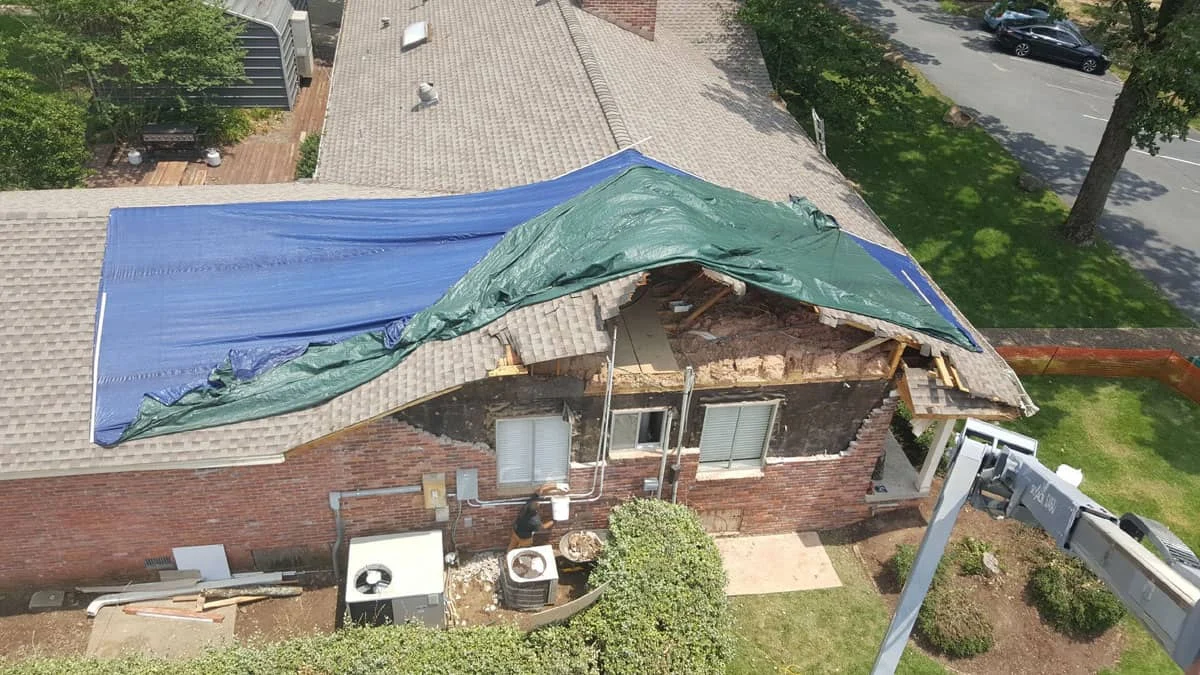
Wind and storm damage roof insurance claim support for commercial buildings across Dayton, Montgomery County, Kettering, Beavercreek, Fairborn, Huber Heights, Vandalia, Miamisburg, Centerville, Springboro, Troy, Xenia, and the Miami Valley.
The call almost never comes in on a calm day. It's a maintenance manager standing under a ceiling stain twenty minutes after a squall line moved through, or a property owner who drove past their building the morning after a severe thunderstorm warning and saw membrane hanging off a parapet. Severe convective storms are the dominant weather threat to Dayton's commercial roof stock — more frequent and, across the metro's inventory as a whole, more consequential than hail or ice. Straight-line winds from these storms have been measured in this region well above the threshold that starts to overload a mechanically fastened membrane system, and the 2019 Memorial Day tornado outbreak remains a reference point for just how severe a single event in this corridor can get.
Wind damage to a low-slope commercial roof rarely announces itself as a single obvious tear. Uplift pressure concentrates at three predictable zones — the roof perimeter, the corners, and the field seams on mechanically fastened membrane — and each behaves differently under load. A perimeter membrane edge can lift, flutter, and settle back down without fully detaching, leaving fastener engagement compromised in a way that's invisible until the next storm finds the weak point. Corner zones see the highest uplift coefficient of any part of a flat roof under ASCE 7 wind design assumptions, which is why we walk corners specifically rather than assuming a roof that looks intact from the parking lot is undamaged. Field seams on TPO or PVC systems can lose weld integrity from repeated flex under gusting wind without a visible gap appearing until water finds it weeks later.
We document all three zones on every post-storm inspection, whether or not there's a visible tear anywhere on the roof. That means photographing and logging perimeter membrane condition around the full building, probing fastener engagement at representative points, checking flashing transitions at parapets and curbs, and inspecting rooftop equipment mounts and penetrations that wind-driven debris commonly strikes. Where uplift stress is suspected but not visually confirmed, we note it as a documented area of concern rather than omitting it — an adjuster working from a report that only shows the one visible tear has no basis to approve a broader scope, even if the roof needs one.
Dayton's building stock adds real variation to how wind damage presents. Distribution and logistics buildings along the I-70/I-75 corridor tend to have large, open membrane fields where wind can travel a long uninterrupted distance across the roof before hitting a parapet or mechanical unit, producing broad low-level stress rather than a single concentrated failure point. Aerospace and defense-adjacent facilities near Wright-Patterson AFB in Fairborn and Beavercreek often have dense rooftop equipment — antennas, specialized HVAC, security infrastructure — where wind-driven debris and equipment vibration under gust load complicate both the damage pattern and the repair-access planning around it. Downtown Dayton's adaptive-reuse buildings, converted from older manufacturing and warehouse stock around districts like Water Street and Webster Station, frequently have parapet walls, cornices, and mixed-vintage roof sections where wind can exploit a transition point between two different roof ages or systems.
Tornado-adjacent wind damage deserves its own note in this market. Storms that produce a documented tornado touchdown nearby, without a direct hit on your building, can still generate turbulent, erratic wind loading that behaves differently than a straight-line event — damage severity on buildings a few hundred feet apart can vary widely. We don't assume a building is undamaged just because it sits outside a mapped tornado path; post-event documentation covers the full roof regardless of the building's proximity to the confirmed touchdown.
Once documentation is complete, we meet the adjuster on the roof and walk them through what we found, zone by zone, with photographs and measurements in hand. Our estimate itemizes the full uplift-related scope — the section that failed outright, and also the perimeter and seam conditions that were stressed and need addressing so the repair doesn't leave a compromised roof that fails again in the next event.
We're your roofing contractor, not a public adjuster — we document and substantiate the wind damage so you and your adjuster work from an accurate, complete scope.
What to send before the roof walk
Send the roof address, any photos taken right after the storm, roof age if known, access instructions, tenant limits, and your carrier's claim number if one has already been issued. That lets the first visit focus on documenting current roof condition.
Questions Owners Ask
Is wind damage to a commercial roof always covered by insurance?
Wind is a named peril on virtually every commercial property policy, but coverage disputes usually come from scope disagreements rather than the peril itself — whether the damage is limited to the visibly torn section or extends into perimeter and seam areas that were stressed but didn't fully detach. Documenting the full uplift zone, beyond the obvious tear, is what supports a broader, more accurate scope.
What does a post-storm roof inspection actually document?
We check membrane perimeter and corner zones where wind uplift concentrates, flashing transitions at walls and curbs, seam integrity on mechanically fastened systems, and rooftop equipment curbs and penetrations. We photograph and log each area whether or not it shows visible damage, because storm-stressed membrane can lose adhesion without fully detaching.
How soon after a storm should I get the roof documented?
As soon as it's safe to access the roof. Early documentation captures the damage before weather, debris cleanup, or a follow-on wind event changes the condition, and it establishes a clear timestamp connecting the damage to the specific storm.
Can wind damage be present even if my roof looks fine from the ground?
Yes. Membrane that was lifted and set back down by wind can lose fastener engagement or seam adhesion without a visible tear. That kind of damage usually isn't found without physically walking the roof and checking perimeter and seam conditions directly.
Does my roofing contractor handle the claim negotiation with my insurer?
No — we're a roofing contractor, not a public adjuster. We provide the roof inspection, photographic evidence, and full-scope repair estimate. Negotiating the claim itself is between you, your carrier, and a public adjuster if you choose to retain one.