
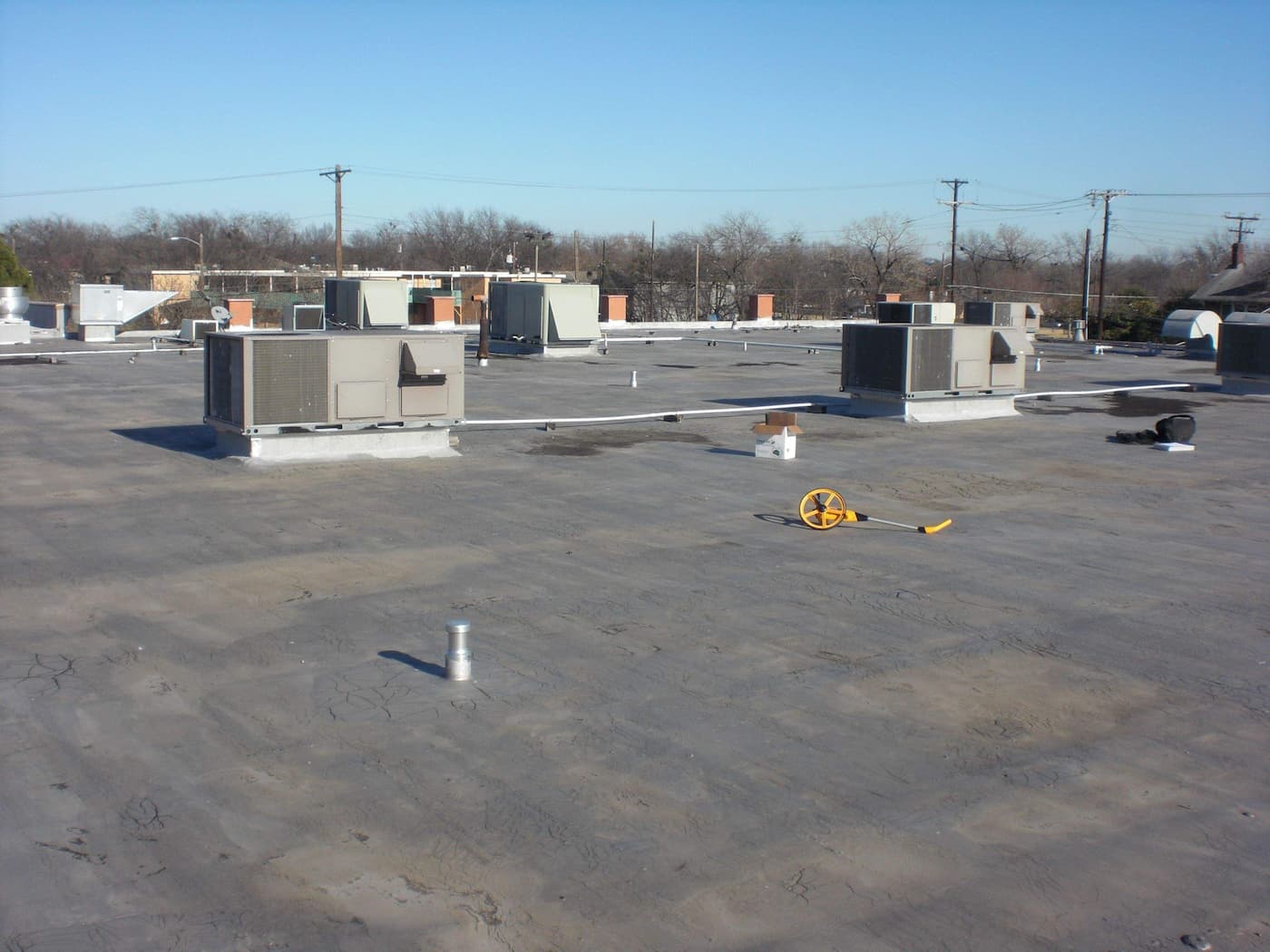
Hail damage roof insurance claim documentation for commercial buildings across Dayton, Montgomery County, Kettering, Beavercreek, Fairborn, Huber Heights, Vandalia, Miamisburg, Centerville, Springboro, Troy, Xenia, and the Miami Valley.
Southwest Ohio sits inside the broader hail belt that tracks up through the Ohio Valley during spring and early summer, when the collision of warm Gulf air and cooler fronts produces the convective storms capable of dropping damaging hail. Dayton's commercial roof inventory takes these events differently than a residential shingle roof does — a flat membrane roof doesn't shatter or crack visibly under hail impact the way a brittle shingle can. Instead it bruises: the membrane compresses at the impact point, granules on modified bitumen cap sheet displace, and metal flashing, coping, and rooftop equipment housings dent. None of that is reliably visible from a parking lot or a drive-by, which is exactly why hail claims on commercial roofs get disputed more often than claims with an obvious hole or tear.
A hail-specific inspection starts with test squares — marked-off sections, typically a few square feet each, placed across representative zones of the roof field rather than just the area someone happened to notice damage. Within each test square we count individual hail strikes, measure impact diameter to characterize the likely stone size, and note whether each strike shows membrane displacement, granule loss, or a puncture. Density and distribution matter as much as any single impact: a roof with strikes concentrated in one corner and scattered elsewhere tells a different story than one with uniform density across the whole field, and that pattern needs to be documented and mapped, in addition to being described.
We supplement the test-square data with close-up photography of individual impact points, wide shots establishing the affected area relative to the building footprint, and inspection of metal components — edge metal, coping caps, rooftop unit housings, and vent stacks — where hail dents are usually easier to see than membrane bruising and can help corroborate the timing and severity of the event. Where the storm date is known or can be identified from weather records, we correlate the observed damage pattern to that specific event, which matters when a carrier questions whether damage is storm-related or pre-existing wear.
Dayton's commercial building stock brings some specific considerations to hail documentation. Large-footprint logistics and distribution buildings along the I-70/I-75 corridor have enough roof area that hail density can vary meaningfully across a single roof — a storm cell's core may have tracked over one half of a warehouse roof and only clipped the other, which is why we test-square multiple zones rather than one representative patch. Aerospace and defense-adjacent facilities near Wright-Patterson AFB often carry a higher density of rooftop equipment, and hail damage to housings, louvers, and antenna mounts on that equipment needs the same documentation rigor as the membrane itself, since equipment damage is frequently part of a legitimate claim scope. Downtown adaptive-reuse buildings with older cap-sheet or built-up roofing sections tend to show granule displacement more visibly than newer single-ply systems, which can work in an owner's favor for documentation but doesn't reduce the need for a systematic test-square survey.
A common dispute point in hail claims is functional damage that hasn't produced a leak yet. Granule loss on a modified bitumen cap sheet exposes the underlying asphalt to UV degradation even when no water is currently getting through — that's a real reduction in the roof's remaining service life, not cosmetic. We document that kind of damage explicitly in our reports, with the reasoning for why it belongs in the claim scope even in the absence of an active leak, because a scope built only around visible leaks tends to understate what the storm actually did to the roof.
Once the survey is complete, we assemble a written report — strike density by zone, stone-size estimate, photographs keyed to a roof diagram, and an itemized repair or replacement scope — and meet the adjuster on the roof to walk through it directly. That's where a documented, methodical hail survey earns its value: an adjuster working from strike-density data and a roof diagram has something concrete to evaluate, rather than a general impression from a walk-through.
We're your roofing contractor, not a public adjuster — we document and substantiate the hail damage so you and your adjuster work from an accurate, complete scope.
What to send before the roof walk
Send the roof address, the approximate storm date if known, any photos taken after the event, roof age, access instructions, and your carrier's claim number if one has been issued.
Questions Owners Ask
How do you prove hail damage on a flat commercial roof?
We mark out test squares across representative sections of the roof and count strike density per square, measure impact diameter to estimate hailstone size, and photograph individual impacts on membrane, metal, and rooftop equipment. That density-and-diameter data is what carriers and adjusters use to confirm a hail event caused the observed damage.
Does small hail damage that isn't leaking still matter for a claim?
Yes. Hail can bruise or displace granules and compress membrane at the impact point without an active leak developing right away. That kind of damage still reduces the roof's remaining service life and UV protection, and it's a legitimate part of a complete hail claim scope even before it causes visible interior leakage.
Can I still file a hail claim if I didn't notice the damage right after the storm?
Often, yes, within your policy's notice window. Hail damage on a flat commercial roof is frequently invisible from the ground and goes unnoticed until a routine inspection or a later leak. We can document the damage and correlate it to a specific past hail event using storm-date records for the property's location.
Do you negotiate the hail claim with my insurance company?
No. We're a roofing contractor, not a public adjuster. We provide the strike-density documentation, damage map, and repair estimate. Negotiating the settlement is between you, your carrier, and a public adjuster if you choose to retain one.
What's the difference between hail damage and normal roof wear?
Hail damage shows a distinct impact pattern — circular bruising, displaced granules in a strike pattern, or dented metal at consistent spacing — that correlates to a specific storm event. Normal wear tends to be more diffuse and gradual, without the concentrated impact pattern hail leaves. A test-square survey is designed to distinguish between the two, which is often the crux of a disputed hail claim.